 DTCEE



220V AC Plug Wiring: Avoid Deadly DIY Fire Hazards
To get a safe 220V AC socket (such as the 4-hole NEMA standard), many people think that it is only necessary to connect the wires to each other: two 110V live wires (red and black) are connected to brass terminals, the neutral wire (white) is connected to silver terminals, and the ground wire (green or bare copper wire) is connected to green hexagonal screws. To tell the truth, it is less than 10% of the whole job to peel a thread and color.
What’s really killing you? If you don’t tighten these thick wires according to the manufacturer’s hard-and-fast torque, thermal expansion and contraction will definitely teach you how to be a human being. Loose joints can produce invisible micro-arcs, which can directly bake the socket and even set the wall on fire. Today, let’s crush this matter and talk about it. We will thoroughly take stock of the hard-core mechanical requirements for connecting 220V sockets without dead corners. By the way, we will pick up 1 and pick up why many people’s own tram charging piles finally burned. Finally, we will give you a set of reliable methods to ensure the safety and stability of high-power electrical appliances in your home.
| NEMA Standard | Typical Use | Black Wire | Red Wire | White Wire | Green/Bare Wire | Terminal Configuration |
|---|---|---|---|---|---|---|
| NEMA 14-30 | 30A electric dryers | Hot Line 1 — X terminal | Hot Line 2 — Y terminal | Neutral — W terminal | Equipment Ground — G terminal | 4-wire: two hots, neutral, and ground |
| NEMA 14-50 | 50A ranges, EV charging, welders, and RV outlets | Hot Line 1 — X terminal | Hot Line 2 — Y terminal | Neutral — W terminal | Equipment Ground — G terminal | 4-wire: two hots, neutral, and ground |
| NEMA 10-30 | Legacy 30A electric dryers | Hot Line 1 — X terminal | Hot Line 2 — Y terminal | Neutral — W terminal | Not provided | Legacy 3-wire: two hots and neutral; no separate equipment ground |
| Connection Function | Standard Wire Color | Electrical Role |
|---|---|---|
| Line 1 / Hot X | Black | Carries approximately 120V to neutral and 240V to the opposite hot conductor |
| Line 2 / Hot Y | Red | Carries approximately 120V to neutral and 240V to the opposite hot conductor |
| Neutral W | White | Supplies the return path for 120V appliance components and unbalanced loads |
| Equipment Ground G | Green or bare copper | Carries fault current during insulation or equipment failure; not intended to carry normal operating current |
The “3-T” Law Of Defense Against High Power
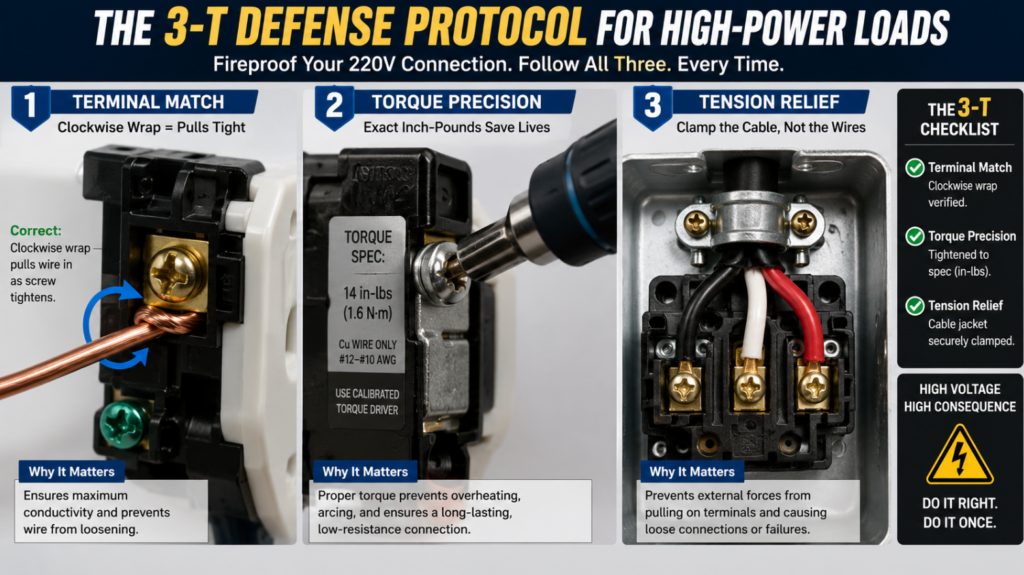
If you want to make a fire-proof 220V connection, you have to remember the “3-T rule”: terminal matching (Terminal match), torque precision (Torque precision) and stress relief (Tension relief).
Terminal matching: When winding the hard single-strand thick copper wire on the terminal screw, it must be wound clockwise. In this way, when you tighten the screw, the wire is tightened towards the center of the screw and will not be squeezed out.
Torque precision: don’t just rely on feeling! You must use a calibrated torque driver to tighten the lug exactly to the “inch-pound (in-lbs)” value printed on the back of the receptacle.
Stress release: the opening of the cable inlet box must be stuck to the outer skin of the cable. In this way, even if someone outside pulls the wire hard, the pull will not go inside to loosen the screw you worked so hard to tighten.
Why Does The Tram Charging Pile Burn? A Lesson About Continuous Load
The tram charging directly tore off the fig leaf of many amateur wiring techniques. You see, the average home dryer usually turns for 45 minutes and stops, pumping about 24 amps on a 30 amp circuit. But what about the tram charging pile? It’s often 40 amps at full charge, 1 10 hours non-stop.
In 2025, a thermal imaging test for residential garages found that 84% of DIY-installed NEMA 14-50 sockets had severe high temperature accumulation (directly above 180 degrees Fahrenheit) at brass terminals. Why? Because everyone is cheap, they bought the kind of household socket designed for the occasional use of electric stoves for more than ten dollars, but they are not willing to spend 50 dollars to buy industrial-grade sockets whose contacts are all large and thick copper sheets and designed for continuous high current. Never forget the “80% rule”: for a 50-amp circuit, the continuous power supply must never exceed 40 amps.
Three Holes Or Four Holes? Avoid The Deadly Pit Of “Zero-Ground Mixing”
When changing lines for old electrical appliances, one step must not be forgotten: separate the zero line and the ground line that were connected together when leaving the factory. Many of the old houses built before 1996 still use three-hole 220V sockets (NEMA 10-30). This old rule actually makes the zero line and the ground line crowded on the same line, which is now non-compliant. The new code requires a four-hole system, and the zero line and the ground line must go separately.
Therefore, if you want to change electrical appliances such as dryers into four-hole plugs, you must remove the metal connection piece that connects the neutral terminal and the metal shell inside the electrical chassis. If you keep it, the entire metal shell of the washing machine or electric welding machine will become the return channel of the current. In case of failure, you may get a direct electric shock by touching the shell.
The Truth In The Industry: Why Do You Think The Wall Is Still Burning When It Is “Tightened?
The most feared thing in this line of work is to rely on your hand. The No. 6 (AWG) or No. 8 single-strand copper wire used in 220V large circuits is thick and hard, and has a very big temper. When I was working by myself, I took an ordinary Phillips screwdriver and felt that it was “dead tight”. In fact, the torque was only 15 inch-pounds at most. But those high-power sockets require 40 to 75 inch-pounds!
If the screw is not really tightened, the copper wire will heat up and expand when large current passes through, and then cool down and shrink after power failure. Every day so hot and cold, the screws will only become looser and looser, and tiny gaps invisible to the naked eye will appear between the metals. When the current jumps through these gaps, a plasma arc of up to 10,000 degrees Fahrenheit will instantly vaporize the insulating plastic and ignite the wooden keel inside the wall. Listen to my 1 advice: buy a torque screwdriver with insulation, this money must not be saved.
FAQ
Do you want to connect the zero line to the 220V circuit?
It depends entirely on what electrical appliances you use. Pure 220V equipment such as floor heaters and water heaters only need two live wires and one ground wire (a total of 3 wires). However, if it is the kind of equipment with both 110V and 220V components (for example, the heating plate is 220V, but the electric furnace with a 110V electronic display screen), it is necessary to pull 1 zero line (a total of 4 lines) to ensure the safe operation of the 110V part.
Can I use the number 12 (AWG) wire to connect the 220V socket?
Absolutely not. Line 12 can only run 20 amps of circuit at the top of the sky (usually it is used for 110V ordinary socket). High-power 220V electrical appliances must be on thick lines to be safe: 30 amps on line 10, 40 amps on line 8, 50 amps on line 6.
What happens if you connect the red and black wires backwards?
It’s okay, the sky won’t fall. Both the red wire and the black wire are 110V live wires pulled out from different phases. They are connected to the two brass terminals of the 220V socket. Changing positions has no effect at all. The voltage is still given and there will be no potential safety hazard.
Can a 110V circuit breaker be equipped with a 220V socket?
It won’t fit. The 220V socket must be equipped with a double-pole circuit breaker, which occupies two pits on your switchboard and draws 110V from both sides of the bus. The single-pole 110V circuit breaker cannot supply the second phase of electricity at all, and cannot make up 220V.
Why does my 220V plug feel so hot?
Hot means too much resistance. Generally speaking, either the screw inside the socket is loose, or the thread is oxidized, or the metal reed inside the old socket loses its elastic clamp and is not tight. In case of this, the power should be cut off quickly. The abnormal hot plug is an ultimatum before the electrical fire.
220V socket wiring can use aluminum wire?
Aluminum wire can be used, but it must be extremely careful and must be equipped with special parts. The degree of thermal expansion and contraction of aluminum is different from that of copper, and it is very easy to oxidize. Once the oxidation resistance rises, it will rub up. If you have to continue to use the old aluminum wire left behind, you must apply anti-oxidation paste (anti-oxidant compound), and the socket must be clearly printed with the words “CO/ALR” or “AL-CU”, otherwise the terminal will catch fire sooner or later.