 datong


What’s The Difference With An Industrial Socket
The core of this distinction lies a single word: reliability under extreme conditions.
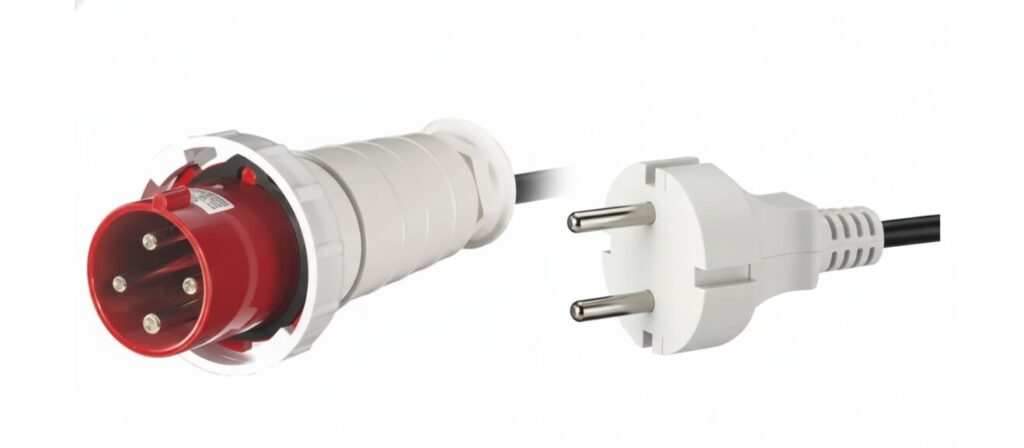
Household outlets are designed for “plug-and-play” convenience, and the environment must be kept at a constant temperature, dry, and clean. Industrial sockets—typically conforming to the IEC 60309 standard issued by the International Electrotechnical Commission—are designed from the outset to withstand harsh environments. Industrial sockets are in a completely different league when it comes to impact resistance, water- and dustproof sealing, and handling the ultra-high current loads required to power heavy-duty machinery. If you expect to power a large motor in a factory workshop using a standard household plastic outlet, you’re just one step away from a serious safety accident.
Safety And Durability Are What Really Matter
The guiding principle behind household power outlets is “convenience.” Their housings are typically made of lightweight plastic, as the home environment is stable and does not require shock or impact resistance.
Industrial sockets are built to really stand up to tough, real-world use. The enclosure material typically features high-impact resistance, ensuring structural integrity even when subjected to heavy impacts in a factory setting or rough handling by maintenance personnel. This is not only for electric shock protection, but also to ensure that the circuit connections remain securely in place even under the high-frequency vibrations generated by heavy machinery. In industrial environments, a poor electrical connection that triggers an arc can result in far more than just the cost of a new outlet.
The “Common Language” Of The Industrial Sector
The IEC 60309 certification is the “access permit” for international industrial plugs.
Unlike household outlets, where standards vary wildly from one region to another, IEC 60309 specifies a set of extremely stringent performance criteria to ensure:
- Voltage and current ratings are clearly marked, so you’ll never make the kind of basic mistake like plugging it into the wrong power source.
- Compatibility: Plugs and sockets from different manufacturers fit together precisely, eliminating any risk of looseness.
- Consistency in performance is the lifeline of expensive industrial equipment.
Don’t Be Fooled By IP Protection Ratings
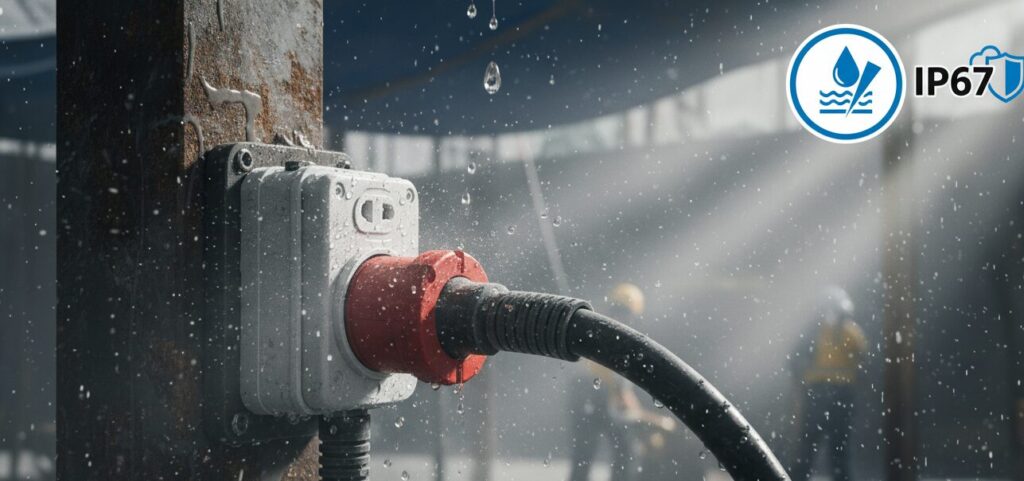
The IP rating that we often talk about is by no means just for show when it comes to industrial sockets. It’s common for household outlets to be vulnerable to water and dust, whereas industrial outlets must be selected based on the specific operating conditions.
At construction sites, wet-processing workshops, or dusty mining areas, you must pay attention to the IP rating. It clearly tells you whether this device can withstand splashing water, a direct water spray, or brief immersion. The industrial-grade sealing design effectively isolates dust and prevents conductive particles from entering the interior, which could cause a short circuit. This is a mandatory requirement under factory fire safety regulations.
The Divide Between Single-Phase And Three-Phase Systems
This is the biggest “critical flaw” in the technical specifications. Industrial equipment consists of heavy-duty three-phase motors and large production lines.
Household outlets typically support single-phase power at 10 to 15 amps.
Industrial sockets are specifically designed for high-voltage, high-current, three-phase loads. It ensures that it does not overheat or melt down even under prolonged, high-load operation. Many people find industrial-grade power outlets bulky, but that size is a necessary trade-off for the reliable, uninterrupted power they deliver.
Why Choose Industrial Sockets
Industrial sockets are not just simple electrical connectors; they are more like a “reliability insurance.” Although household plugs have made compromises for the sake of convenience, in the industrial sector, what we need is a robust safeguard that can support heavy-duty equipment and withstand high-pressure environments. When choosing industrial sockets, what matters most is the confidence instilled by the IEC 60309 standard, as well as the assurance that the circuit will remain rock-solid even under sudden, harsh operating conditions.
Author: Alex Reed
Hi, I’m an electrical engineer with over 12 years of field experience in industrial power distribution. Throughout my career, I’ve seen firsthand how the right electrical infrastructure is the difference between a seamless operation and a critical failure.