 datong


Should You Use Socket Covers
The answer to the question is absolutely yes. You have to get one of those spring-loaded, all-in-one, heavy-duty industrial socket covers.
In the new energy or heavy machinery manufacturing industry, there is always a high current of 63A or even 125A. These covers are actually life-saving walls. They block conductive dust, are waterproof, and can also prevent people from accidentally hitting live terminals. These covers are the basic work to save the system’s IP (protection level) and minimize the risk of short circuit, arc flashover or direct equipment collapse. Covering every idle socket tightly is not only to cope with international safety standard inspections, but also to keep the high-current connectors and prevent them from being oxidized or discarded by industrial debris.
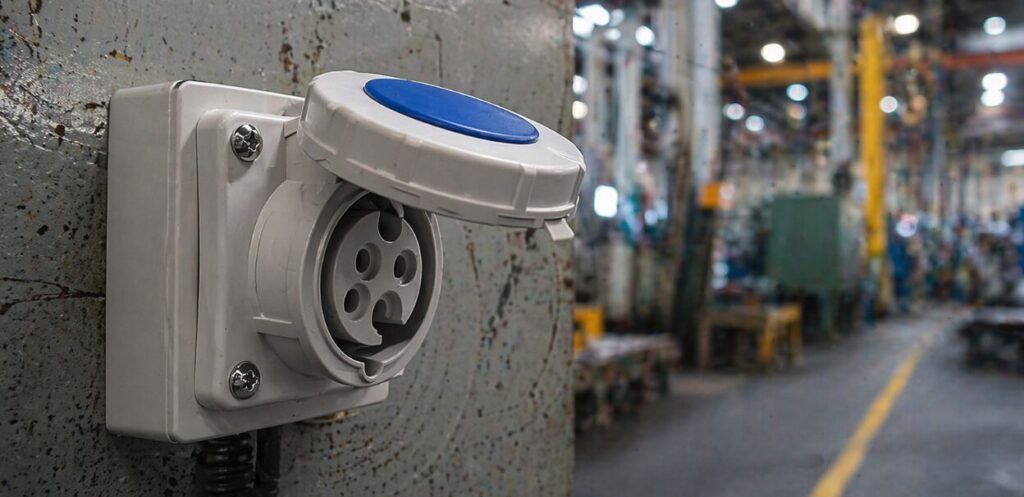
Why Doesn’t “Routine Operation” Work On An Industrial Site?
At home, the socket cover is at best a thing to prevent children from picking at it. But in industrial sites, these are two completely different things. When we are discussing whether or not to use socket covers in factories, power stations or outdoor projects, we are essentially talking about environmental sealing and the integrity of the circuit.
The industrial environment is inherently accompanied by the word “harsh”. Whether you’re tending to a windswept new energy base or staring at a heavy assembly line with machines blaring, your electrical components are under threat every moment. Once outlets are exposed, your electrical infrastructure can leak through these risks:
- Tiny particulate matter: In production workshops, metal dust, wood chips or carbon fiber floating in the air can easily fall into unobstructed jacks. Normally, these conductive materials will slowly connect the terminals, then creep in, short out, and finally catch fire.
- Moisture and moisture: High current connections ——especially those carrying a full 63A or 125A load, which are extremely sensitive to water. Once water enters, corrosion is incredibly fast. This causes the contact resistance to rise in a straight line, and the device can generate extremely dangerously high temperatures as soon as it runs.
- Chemical exposure: In today’s factories, various aerosols, cutting fluids, lubricants or powerful cleaning agents are everywhere. Without a cover to block it, these chemicals will settle in the socket, slowly corroding the internal insulation layer, and even the outer shell material will slowly degrade.
Technical Advantages Of Integrated Industrial Socket Covers
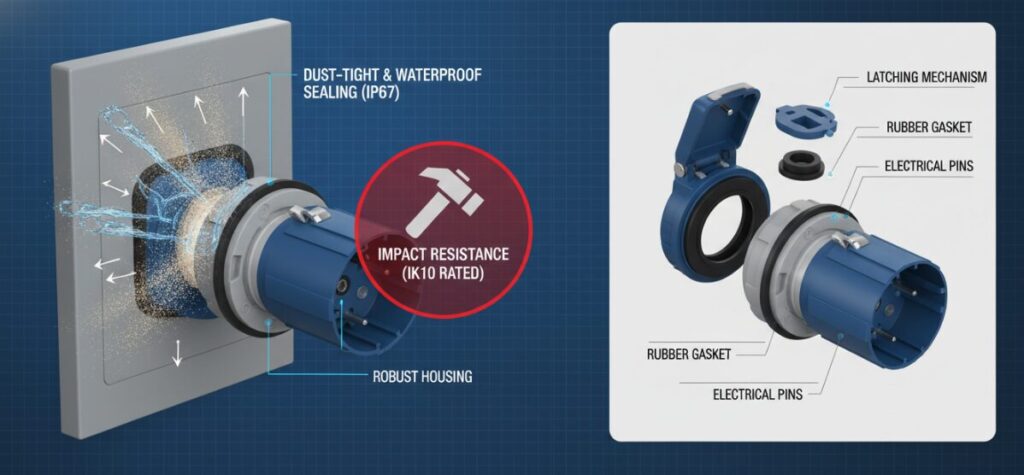
To understand why this protective cover is a “non-standard” dead rule, we need to see what practical technical advantages it brings to industrial power distribution systems.
1. Maintaining the integrity of IP protection levels
Every qualified industrial socket has strict IP protection level certification when it leaves the factory, such as IP44 (splashproof) or IP67 (watertight). Many people overlooked a fatal premise: this rating only counts when the outlet has a matching plug plugged in, or when the protective cover that comes with it is completely closed. You hang it bare in a flushing area, a dusty workshop or an outdoor power grid, and its safety level instantly drops to zero, and a high-precision component becomes a hidden danger point on the spot.
2. Preventing Arc Flash Dangers
The arc flashover thing is extremely destructive. The current is in the air between the conductors “out of the way”. In high-voltage, high-current applications that power heavy machinery worldwide, even a tiny speck of conductive debris or moisture invisible to the naked eye in an open socket will reduce the insulation resistance of the air gap. One day someone will jerk the plug into this problematic outlet, and the instant connection could trigger a fatal flashover. Not only are the operators extremely dangerous, but the surrounding equipment will also be scrapped.
3. Extend the life of high-current contacts
For those plants that use 125A heavy-duty sockets, the pins inside are precision machined for optimal conductivity. If exposed to open air all the time, the oxidation rate will double. Add a sturdy, spring-loaded flip cover to keep those flimsy silver-plated or brass contacts clean. This clean and original state ensures that the machine is connected with low resistance every time it is powered on, and the service life of the plug and socket will naturally be longer.
Compliance And Safety Standards
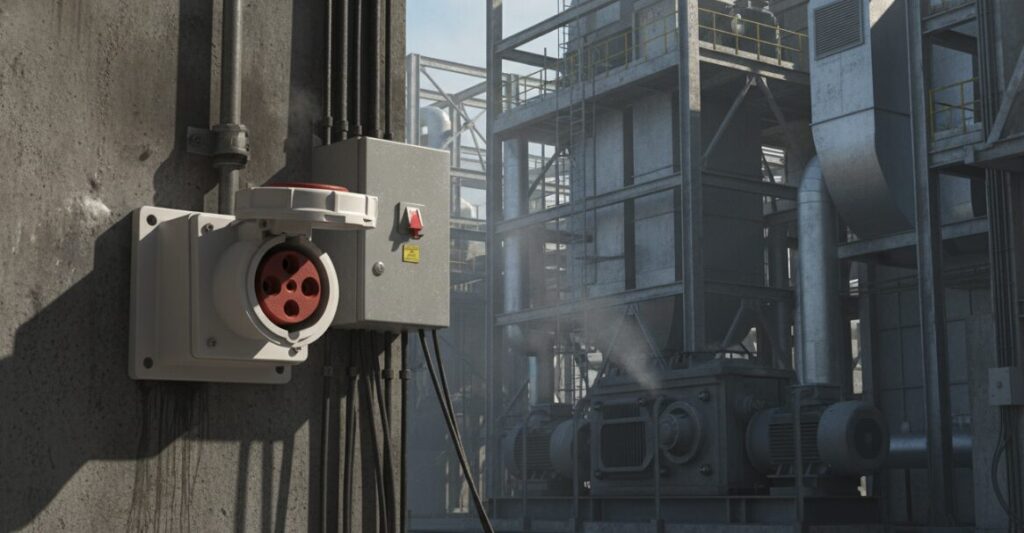
From a safety review perspective, putting covers on sockets is really not a “icing on the cake” plus, which is the mandatory benchmark for “good housekeeping on site” and “preventive electrical maintenance”. International electrical standards like IEC 60309 clearly and strongly emphasize the need for an enclosure to provide continuous protection against the effects of the external environment.
If your plant is responsible for powering critical new energy grids or heavy industrial equipment, internal safety protocols must bite the bullet with the following operating ironclad rules:
- Continuous sealing: All idle spigots must always be tightly fastened with the built-in protective cover.
- Routine Inspection: During the standard maintenance inspection every quarter, you must carefully check whether the cover sealing gasket is OK and whether the spring tension is sufficient.
- Zero tolerance damage: If the cover is even just a tear, crack or loose, it must be replaced immediately and the original IP rating of the shell must be restored.
Author: David Chen
“I am a Senior Electrical Engineer with over 17 years of experience in industrial power distribution and site safety compliance. My mission is to help facility managers bridge the gap between ‘getting the job done’ and ‘doing it safely,’ ensuring your critical infrastructure remains protected in even the harshest industrial environments.”