 داتونج


ما نوع البلاستيك المصنوع منه مقبس القابس الكهربائي
Ordinary household socket is mainly urea formaldehyde resin, which is a kind of thermosetting plastic, insulation and heat resistance is really not to say, heat does not melt is its biggest confidence. But if we switch to high-performance industrial scenarios such as renewable energy or heavy machinery, we usually choose polycarbonate or polyamide. These are high-strength thermoplastics, which are not only resistant to operation, but also have a fire rating of UL 94 V-0, and are resistant to chemical corrosion and ultraviolet rays.
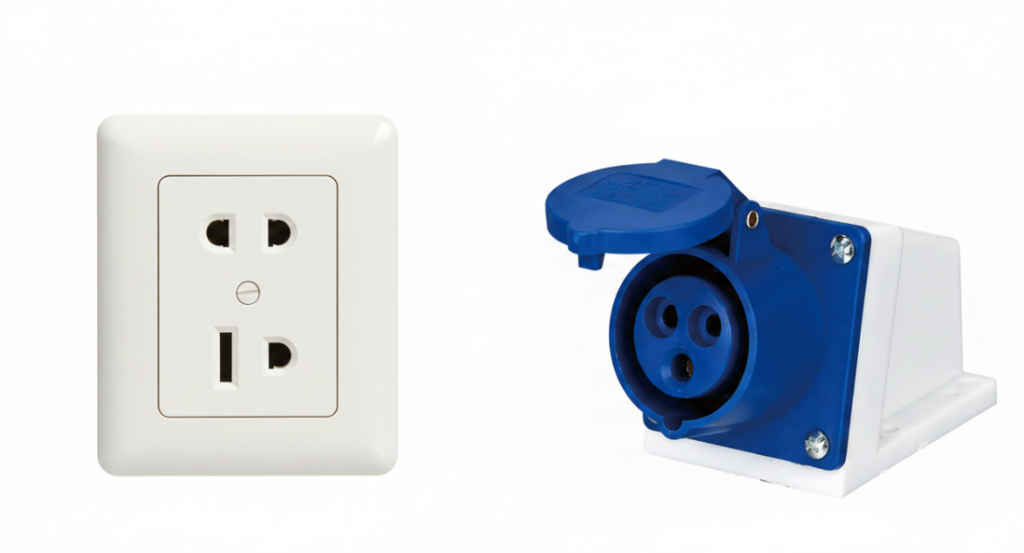
The Science Behind Home Safety
In the residential environment, our core demand is actually fire prevention in a static environment. Urea-formaldehyde resin is a thermosetting polymer. After heating and pressing, its molecules will be chemically cross-linked to form a permanent 3D network structure.
Once this structure is set, it can no longer be melted twice. For household sockets, this is a life-saving feature. In case the internal wiring is loose and local high temperature is generated, the shell made of UF will not flow all over the floor like those cheap goods, but will directly carbonize and turn black, thus maintaining the shape of the socket and isolating the internal live parts. Coupled with its extremely high dielectric strength and resistance to “arc tracking”, this is why it is still the standard for white household switch socket panels for so many years.
Industrial Grade Spanning
When you move from the living room to an industrial site, such as a photovoltaic power station or a large mechanical production workshop, the material requirements are upgraded from simple “heat resistance” to “extreme environmental adaptability”. At this time, PC and PA66 this advanced thermoplastic should play.
Polycarbonate Is Responsible For Impact Resistance
What I see most about the PC is its toughness. Although UF material is heat-resistant, it can’t help falling, and it is easy to crack if it is slightly affected by external force. But in the industrial environment, the equipment often bumps, the socket has to withstand all kinds of vibration. This almost “unbreakable” feature of PC can ensure that even under the rudest operation, the internal electrical contacts can be stably protected by the shell and will not be disturbed by the outside world.
Polyamide Treatment Chemistry And Thermal Stress
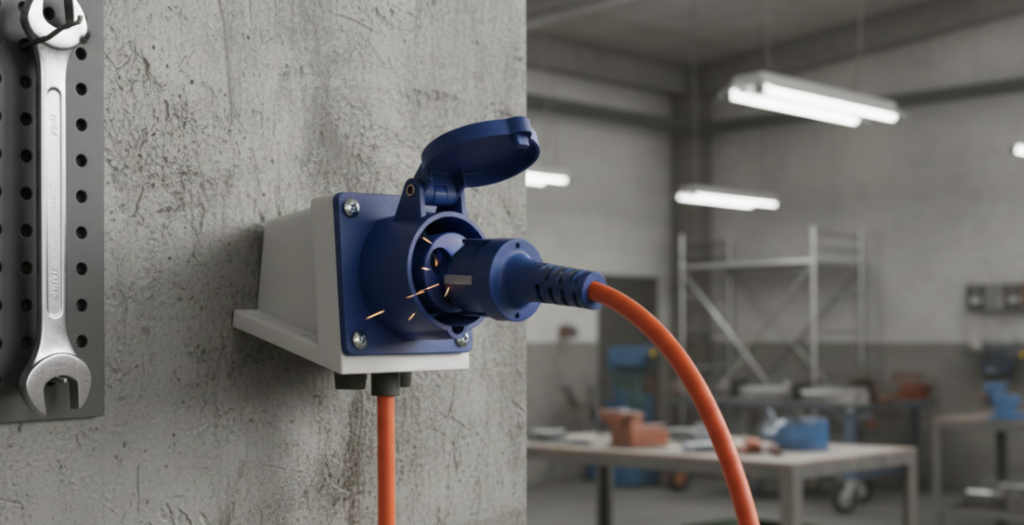
PA66 is what we often call nylon, which is seen very much in heavy industrial plugs and sockets. It has a high melting point and wear resistance. When dealing with 63A or 125A high current load, the internal temperature rise is often very obvious. PA66 can still maintain mechanical rigidity and insulation under such continuous high temperature, and will not become soft deformation.
Core Performance Indicators
Flame retardant rating: In industrial scenarios, PC or PA66 must be modified. This means that in the event of a real fire, the flame must extinguish itself within 10 seconds, and it must not produce the kind of molten droplets with fire to ignite the material below.
UV resistance and chemical resistance: outdoor scenes like wind farms or photovoltaic arrays, where sockets are exposed to the sun every day, ordinary plastics will soon turn yellow and brittle. The industrial-grade PC and PA66 are specially designed to withstand ultraviolet aging. And they are extremely resistant to oils, greases and various industrial solvents. If ordinary household UF materials are thrown into this environment, they will have to be scrapped before long.
Engineer’s Summary: Materials Must Match Current And Environment
All in all, the choice of plastic is entirely a precision engineering decision based on the charge load and the environment in which it is used. Urea formaldehyde resin is more than enough to handle low-current household environments, but when it comes to industrial machinery or energy infrastructure, switching to PC and PA66 is a must, and there is no room for compromise. Especially for 63A to 125A systems, the impact resistance and chemical stability provided by high-strength thermoplastics is the only way to ensure the long-term safe operation of the system.
Author: Robert Sterling
My career has been spent in laboratories and on-site at large-scale industrial projects, specifically analyzing how polymer integrity prevents catastrophic electrical failures. I’m dedicated to breaking down complex technical standards to help the next generation of engineers and contractors choose the safest, most durable equipment for their specific environments.