 datong


¿Qué es una toma de corriente estándar?
60Explore los tipos de enchufes, voltajes y normas de seguridad globales como UL/CE para garantizar una infraestructura eléctrica segura.
Ver detallesBuscar en toda la estación
The so-called “standard socket voltage” is actually a pseudo-proposition—— is not a single value, but a specification divided into two levels: civil and industrial. Globally, civilian single-phase AC power generally falls into two categories: 110-120V/60Hz and 220-240V/50Hz. But when it comes to industrial applications and heavy machinery deployment, the standard jumps to three-phase power supply systems, which generally range from 380V-415V in the IEC standard area to 440V-480V in the NEMA standard area. Understanding the difference between the two is crucial because high-current equipment ——such as renewable energy systems or global production line machinery—— requires extremely precise voltage and frequency synchronization. If you make a mistake, the motor may be damaged or the circuit breaker may trip, and in the worst case, the equipment may be destroyed. Therefore, when selecting industrial connectors, engineers must adhere to the IEC 60309 standard and use color coding to ensure that the current intensity and the clock position of the ground contacts can be exactly matched to the local distribution network.
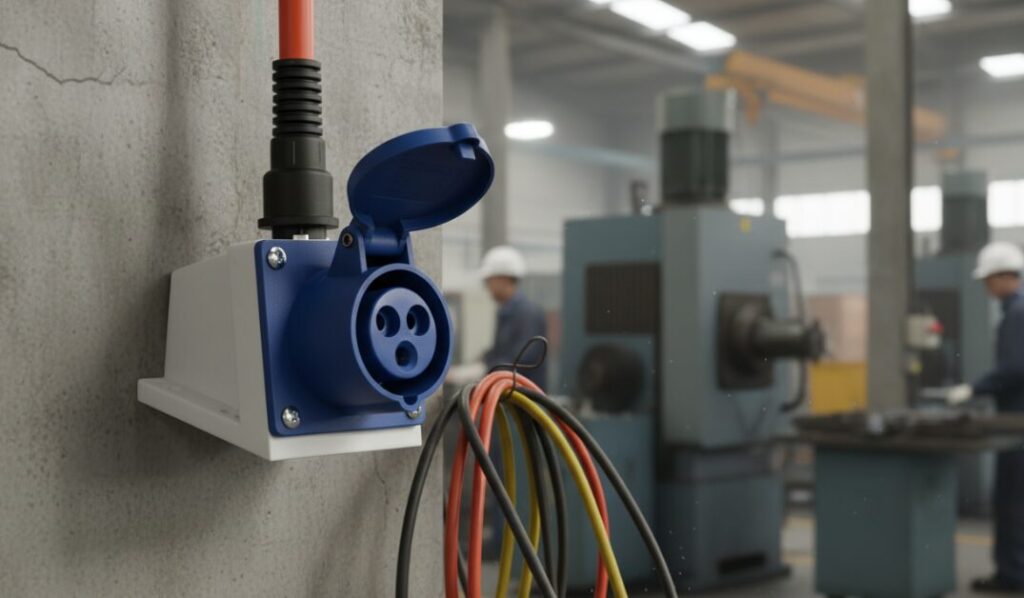
In civil or commercial environments, everyone focuses on single-phase AC power that powers low-power devices. But in industry, “the standard” is entirely dictated by the needs of high-torque motors and high-power distribution units.
If an engineer only designs a machine to fit a so-called “220V country”, it will most likely cause problems. If this machine requires a three-phase 400V industrial socket to operate, 220V single-phase electricity alone is not enough. The leap from civilian to industrial means that the wiring method has changed from a two-wire or three-wire system to a four-wire or five-wire system. This is the universal logic that ensures the stable power supply of heavy equipment and cannot be discussed.
In addition to the voltage value, the frequency is like the power supply “heartbeat”. Although 110-120V is almost always tied to 60Hz, and 220-240V follows 50Hz, industrial exports must pay attention to those regional “pits”.
The reason why frequency synchronization is hanging by a thread is that AC motors are extremely sensitive to frequency. If you took an industrial pump designed for a 60Hz North American grid and connected it to a 50Hz European grid through a regular industrial plug, the motor would spin 20% slower. This results in reduced cooling efficiency, a crazy buildup of heat, and ultimately the motor simply dies. High current applications, especially in the renewable energy sector, simply cannot withstand this kind of effort. Therefore, choosing an industrial connector with correct rated parameters is actually the first line of defense for safe production.
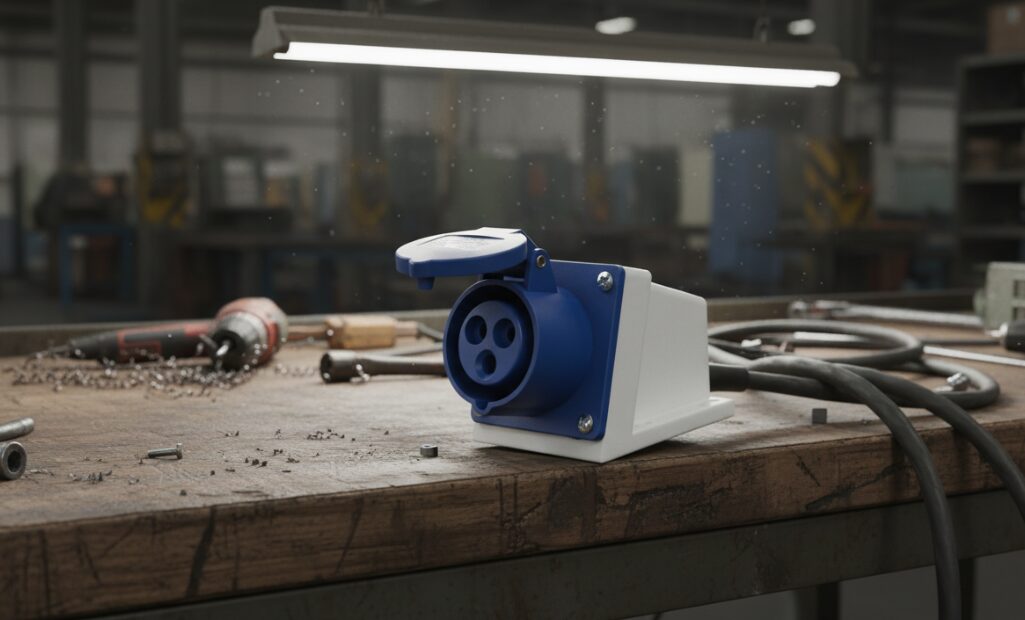
To avoid the kind of equipment-devastating disaster mentioned at the beginning, the IEC 60309 standard is commonly used in the international electrical community. This system actually establishes a visual and physical “lock-key mechanism” for industrial sockets.
Color Coding: For engineers, the most intuitive thing is the color of the connector housing. Blue represents the 200-250V voltage range, while red is the global pass for 380-480V systems.
Clock position: The “clock position” of the ground contact is the second layer of security. It ensures that a plug designed for a certain voltage cannot physically fit into another voltage level socket, even if they have the same number of pins.
Current handling capability: Faced with heavy machinery deployment, standard connectors must be able to withstand high currents, such as 63A or 125A. This is necessary to deal with the heat load generated by the continuous operation of industry, otherwise it is only a matter of time before the shell melts or an arc flashover occurs.
For industrial equipment exporters, the consequences of voltage mismatch are enormous. Circuit breaker tripping due to load imbalance or voltage fluctuations can shut down an entire production line or even damage expensive renewable energy inverters.
After spending a lot of time in this circle you will understand that the core need of an engineer is not just to know what the voltage is, but how to ensure “continuity of power supply”. By using industrial plugs and sockets that strictly comply with international voltage and frequency standards, exporters can guarantee that their equipment can be “eaten” in the distribution infrastructure anywhere in the world. Whether it’s the 63A specification required for mobile generators or the 125A socket used in wind turbine projects, the standard voltage must match connectors that are highly conductive, have strong insulation properties, and are safety certified.
Author: Robert Sterling
Having spent much of my career troubleshooting electrical systems across multiple continents, I’ve seen firsthand how a simple voltage or frequency misunderstanding can derail a multi-million dollar industrial project. I specialize in helping cross-border manufacturers navigate complex grid requirements to ensure their heavy-duty machinery operates safely and efficiently, no matter where in the world it’s deployed.

Explore los tipos de enchufes, voltajes y normas de seguridad globales como UL/CE para garantizar una infraestructura eléctrica segura.
Ver detalles
Aprenda métodos profesionales para comprobar enchufes industriales, diagnosticar averías y evitar peligrosos incendios eléctricos.
Ver detalles
Solución de averías en enchufes: Restablezca los GFCI, repare los disyuntores y evite las sobrecargas con consejos profesionales de seguridad eléctrica.
Ver detalles
Conozca las normas mundiales de tensión (120 V frente a 230 V), frecuencia y enchufe para garantizar la seguridad de los equipos industriales.
Ver detalles
HolaConéctese