 datong


O que fazer quando a tomada rebenta
24Actue rapidamente no caso de uma tomada industrial queimada! Siga este plano de emergência para evitar incêndios eléctricos e resolver sobrecargas de energia.
Ver pormenoresPesquisar toda a estação
Globally, there are exactly 15 types of household AC power plugs and sockets officially recognized by the U.S. Department of Commerce, ranging from Type A to Type O. The specific pin arrangement and safety standards vary by region (such as the NEMA standard used in the Americas, or the Schuko plug in Europe).
However, this statement actually only applies to civilian homes. Once we move into specialized areas like heavy machinery or harsh environments, industrial plugs and sockets are no longer categorized by a few simple letters. They are subject to strict compliance with the international standard IEC 60309, under which hundreds and thousands of specific socket types have been born. How to distinguish? It is mainly divided by voltage color code (such as yellow 110V, blue 230V, red 400V), current capacity (16A, 32A, 63A, 125A) and IP protection level (such as IP44 water-proof or IP67 water-proof and dust-proof). There are only 15 basic models for home use, but on the industrial side, it is an extremely large and highly standardized matrix to meet global security and power supply needs.
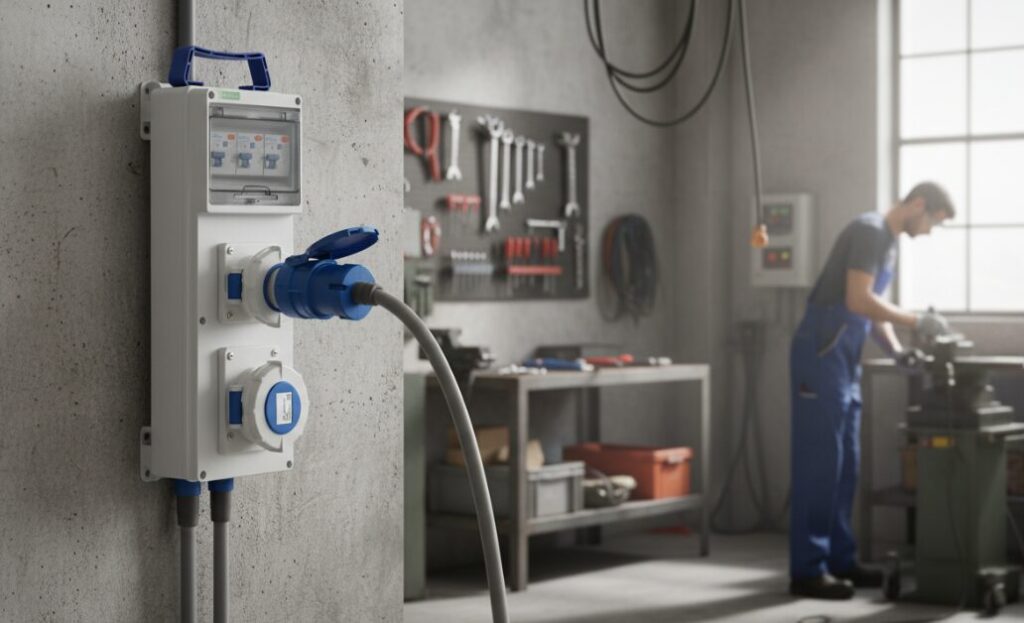
To standardize power connections worldwide for the average consumer, the U.S. Department of Commerce officially recognizes 15 basic designs.
These configurations, arranged alphabetically from A to O, are actually caused by the different historical developments of power grids in different places. For example, the Americas rely heavily on NEMA standards (usually Type A and B), while European countries tend to use the highly secure Schuko plug design (also known as Type F) on a large scale. These 15 basic outlets are perfectly adequate for handling the low power demands of TVs, laptops, and home appliances. But this letter-based classification completely fails once it’s outside of residential and light commercial settings.
So what happens when you entering a manufacturing plant, a construction site, or a new energy facility? The demand for electricity and the degree of danger to the environment are increasing exponentially.
Heavy machinery and harsh environments require that connectors never fail under pressure, moisture, or heavy electrical loads. Because of this, Industrial sockets follow the IEC 60309 international standard. This is no longer just 15 things, but an extremely large, highly specific socket matrix constructed through three key factors: voltage color code, current capacity, and IP protection level.
In that kind of messy and busy industrial site, in order to ensure that everyone knows safety at a glance and prevent catastrophic misinsertion, IEC 60309 uses a common color code system to mark voltage ratings. No matter where you are in the world, an engineer can tell exactly what power a socket is dealing with by looking at its color:
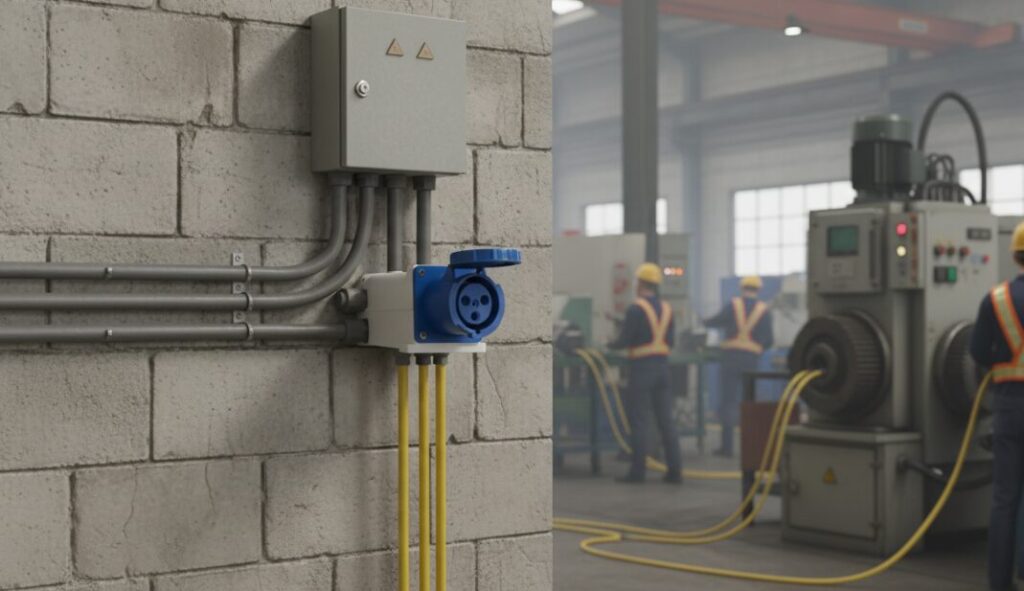
The sockets on your wall are limited to 10A to 15A at best, but industrial sockets are designed to carry high currents continuously. The standard divides them into several clear current echelons ——16A, 32A, 63A, and 125A.
Take the 63A’s wide-voltage industrial plug, for example, which we often use to power energy-intensive global machinery and factory equipment. In extremely demanding continuous load industries, such as large-scale new energy projects and heavy industrial plants, they are basically supported by the leather-hardy and durable 125A industrial sockets. There’s a clever design at the beginning: the physical dimensions of the socket scale with the current capacity. You want to plug a low-rated plug into a high-capacity outlet? It’s physically impossible to plug in.
Where in the house are outlets exposed to rain, mud or chemical dust. But industrial sockets are different, they must not find fault at all in the harshest conditions. Therefore, the types of sockets in the industrial sector must be multiplied several times according to their protection (IP) level:
Author: Alex Mercer
“Hi, I’m an electrical engineer and industrial power specialist with over a decade of experience in heavy-duty connections. Throughout my career, I’ve worked across manufacturing plants, new energy facilities, and harsh outdoor construction sites. I’m passionate about translating complex electrical standards—like IEC 60309—into practical knowledge.

Actue rapidamente no caso de uma tomada industrial queimada! Siga este plano de emergência para evitar incêndios eléctricos e resolver sobrecargas de energia.
Ver pormenores
Aprenda a atualizar os circuitos industriais com o meu guia de 3 passos: De disjuntores a tomadas IEC 60309 para potência máxima.
Ver pormenores
Os protectores de tomadas são seguros? Descubra porque é que as coberturas IEC 60309 são vitais para a segurança eléctrica industrial e classificações IP.
Ver pormenores
A tomada morreu de repente? Descubra as causas mais comuns, passos fáceis para a resolução de problemas e como detetar com segurança os riscos de incêndio elétrico.
Ver pormenores
OláIniciar sessão