 datong


Plug 110v To 120v? 115v Into 110v Outlet Safety [2026]
Yes. You can safely plug a 110V, 115V, or 120V appliance into any standard North American outlet interchangeably. These numbers represent the exact same voltage class under current electrical standards. Your device will not explode, catch fire, or suffer damage from this specific voltage variance. The real danger hidden in your wall has absolutely nothing to do with a 5-volt or 10-volt label difference. House fires and dead appliances in 2026 stem from smart panel misreadings, hazardous Japanese 100V imports, and hidden amperage overloads on aging wiring. We mapped the exact failure points of cross-voltage plugging below.
The Short Answer: Why 110V, 115V, And 120V Are Identical
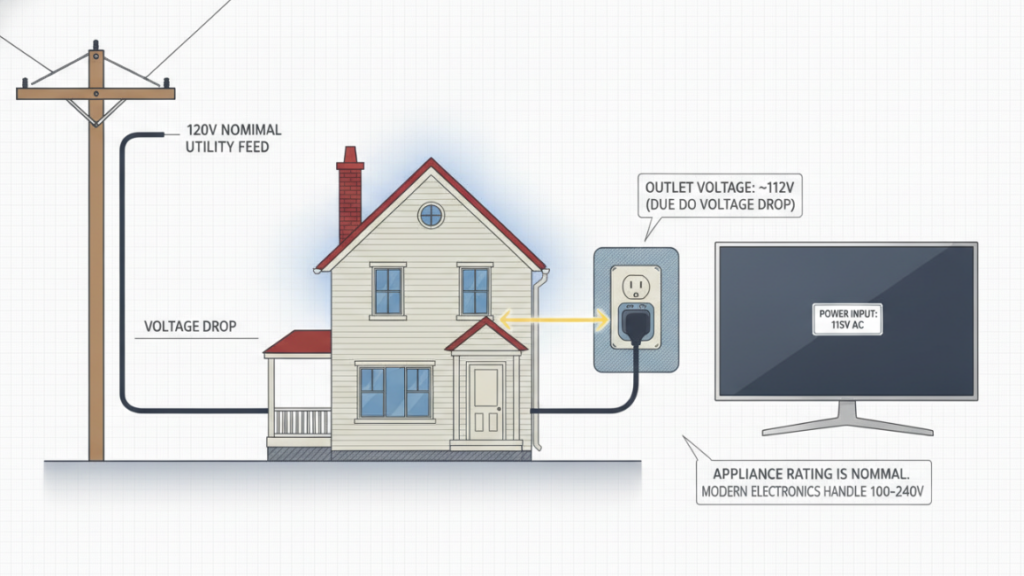
Appliance manufacturers use 110V, 115V, and 120V to describe the exact same power requirement. North American power grids deliver a nominal 120 volts to your electrical panel. The ANSI C84.1 standard legally permits this utility voltage to fluctuate anywhere between 114V and 126V.
Historical standards caused this labeling mismatch. The grid operated closer to 110V a century ago, shifted to 115V post-WWII, and eventually standardized at 120V. Companies simply kept old naming conventions for marketing or legacy manufacturing reasons. Your modern television labeled “110V” is engineered with internal power supplies built to handle anything from 100V up to 240V in most cases.
The V-A-H 3-Second Audit Rule For Appliance Safety
Stop worrying about the 110V to 120V variance. Check your device against the V-A-H (Voltage, Amperage, Hertz) framework before pushing a foreign or high-power plug into a wall receptacle.
Voltage (The 10% Tolerance Window)
Electrical devices tolerate a 10% voltage swing without performance drops. A device labeled 110V safely handles up to 121V. A device labeled 120V functions perfectly down to 108V. You only face risk if you exceed a 20% variance.
Amperage (The Fire Starter)
Mismatched amps cause electrical fires, not mismatched 120-volt class voltages. A 110V space heater pulling 15 amps will immediately melt the wiring of a 15-amp bedroom circuit if you also turn on a vacuum cleaner. You must check the amp rating (A) or wattage (W) on the device label to ensure it does not exceed 1,440 watts of continuous load on a standard household breaker.
Hertz (The Motor Killer)
North America runs on 60Hz. Many international appliances operate on 50Hz. Plugging a 50Hz mechanical appliance (like a vintage clock or a specialized European blender) into a 60Hz outlet makes the internal motor spin 20% faster than designed. The motor will overheat and burn out within months, regardless of the voltage matching perfectly.
| Label Voltage | Actual Outlet Voltage (North America) | Safety Status |
| 120V | 120V | Safe (Perfect Match) |
| 115V | 120V | Safe (Standard Design) |
| 110V | 120V | Safe (Legacy Rating) |
| 100V | 120V | Fire Risk / Damage Risk (Overvoltage) |
| 220V | 120V | Damage Risk (Under-voltage / Motor Stalling) |
Real-World Scenarios Answered
Users search for exact voltage match scenarios based on what is printed on their device tags. We break down the three most common situations below using actual electrical grid physics.
can i plug 110v to 120v
If you are asking, can I plug 110V to 120V, the answer is an absolute yes. A device marked strictly as 110V is fully capable of consuming the 120 volts supplied by a modern wall outlet. The internal components, including capacitors and resistors, possess overhead ratings far exceeding 120 volts. You plug it in normally without any voltage converter.
can i plug 115v into a 110v outlet
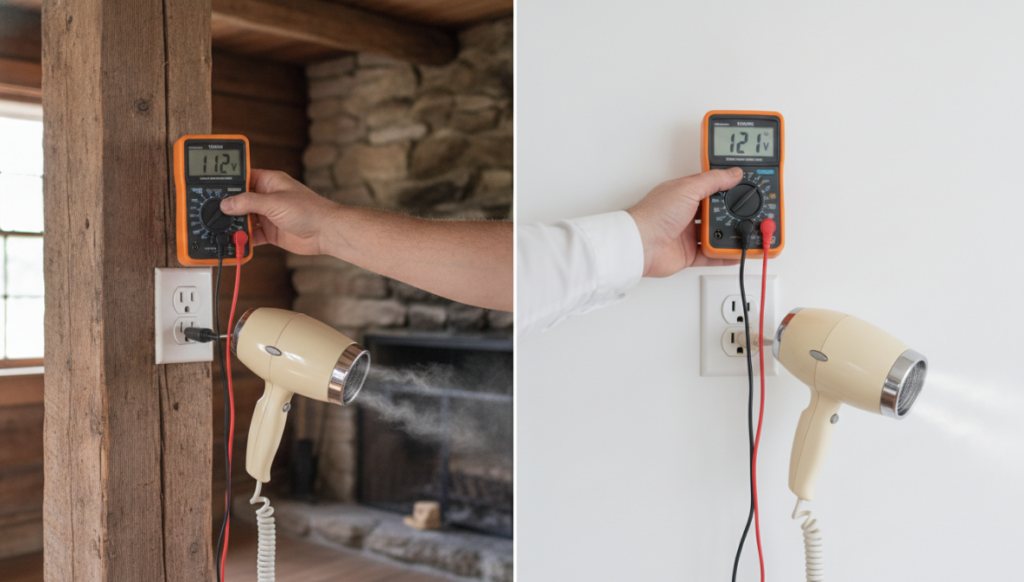
Old house owners frequently ask, can I plug 115V into a 110V outlet. You absolutely can. People call older receptacles “110V outlets” because old house wiring suffers from severe voltage drop. A multimeter reading at the end of a 50-foot run of 1960s wire might show 111 or 112 volts instead of 120. Your 115V appliance expects this drop and will run perfectly fine on 110 volts.
can i plug 120v into 110v
Moving an appliance to a different room or a rural cabin makes people wonder, can I plug 120V into 110V. The grid treats these entirely as the same 120-volt standard. A modern 120V power tool will spin up and operate safely even if the rural outlet is only delivering 110 volts due to grid strain or long utility lines. You might experience a 2% drop in peak motor torque, but no safety hazard exists.
The 2026 App Anxiety: Why Your Smart Panel Shows 122V
Smart electrical panels installed in 2026 generate unnecessary panic among homeowners. Devices like SPAN or Leviton smart load centers push real-time voltage readings directly to your smartphone. Seeing 122.5V on the app while holding an expensive espresso machine labeled “110V” triggers immediate hesitation.
This data visibility is a diagnostic tool, not a warning siren. Utility companies intentionally push voltage slightly higher (around 122V-124V) at the service drop to ensure homes at the end of the neighborhood grid still receive adequate power during peak hours. Your appliance manufacturer built the device knowing the grid fluctuates. Ignore the exact decimal on your smart app as long as it stays between 114V and 125V.
The Real Danger: The “100V Japanese Import” Trap
The actual threat in cross-voltage applications involves Japanese appliances. Japan operates on a strict 100V system. Appliance buyers frequently import high-end Zojirushi rice cookers or Dyson hair dryers from Tokyo and plug them directly into North American 120V outlets without converters.
A 20-volt difference sounds minimal, but it represents a massive 20% overvoltage. Ohm’s Law dictates that pushing 120V through a heating element engineered for 100V forces the device to pull significantly more wattage than designed. The heating coils will glow hotter, degrade rapidly, and short-circuit. You must use a specialized step-down transformer (120V to 100V) for Japanese imports, especially high-wattage heating devices.
SSS
Do I need a voltage converter for 110V to 120V?
No. You do not need any type of transformer, converter, or adapter. The plug shapes are identical (NEMA 5-15), and the internal power requirements are natively compatible.
Why does my appliance say 115V instead of 120V?
Manufacturers label products with 115V to indicate the “utilization voltage.” They assume a 5-volt drop occurs as electricity travels from your 120V electrical panel through the wires inside your walls to the physical outlet.
Can plugging a 110V device into a 120V outlet cause a fire?
No. Voltage differences in this specific range do not cause fires. Overloading the circuit’s amperage (plugging too many high-power devices into one circuit) or using frayed cords is what triggers electrical fires.
Is an American outlet 110V or 120V?
The official standard in the United States and Canada is 120V. People still use the term “110V outlet” purely out of habit passed down from older generations when the grid ran at lower voltages.
Can I use a 220V appliance in a 110V/120V outlet?
No. You cannot physically plug it in without forcing the prongs, and doing so via an adapter will severely underpower the device. A 220V device receiving only 120V will either fail to turn on or run so poorly it damages its own internal motor.
Does a lower voltage like 110V consume less electricity than 120V?
No. Devices consume wattage, which is voltage multiplied by amperage. If the voltage drops from 120V to 110V, a mechanical device will simply pull more amps to achieve the same work, resulting in identical energy consumption on your utility bill.