 datong


Can A Wall Socket Kill
The answer is yes, and absolutely.
Whether it’s a 120V or 220V standard alternating current (AC) wall socket, just 50 to 100 milliamperes (mA) of current is enough to trigger fatal ventricular fibrillation and deliver a devastating electric shock to the body. This is scary enough in a normal office environment, but if you switch the scene to a commercial and industrial environment, the danger index is simply exponential.
Some companies are actually using power connections that do not meet the standards when running heavy equipment, large multinational machinery or new energy infrastructure. It’s not just about risking a local short circuit, it’s about betting on catastrophic electric shocks and serious facility fires. You know, in a harsh environment filled with moisture, dust, mechanical vibration and continuous high ampere current, the contacts of ordinary sockets age very quickly, the insulation resistance drops sharply, and the exposed wires and thermal overload problems soar. To completely eliminate these deadly hazards and protect human lives and expensive assets, traditional sockets must be decisively eliminated from industrial sites. You have to use heavy-duty, high-IP protection industrial sockets. After all, under extreme operating pressures, only they can ensure that the connection is absolutely secure, extremely waterproof and dustproof, and strictly comply with safety regulations.
The Fatal Mechanism Of Electric Shock From A Standard Wall Socket
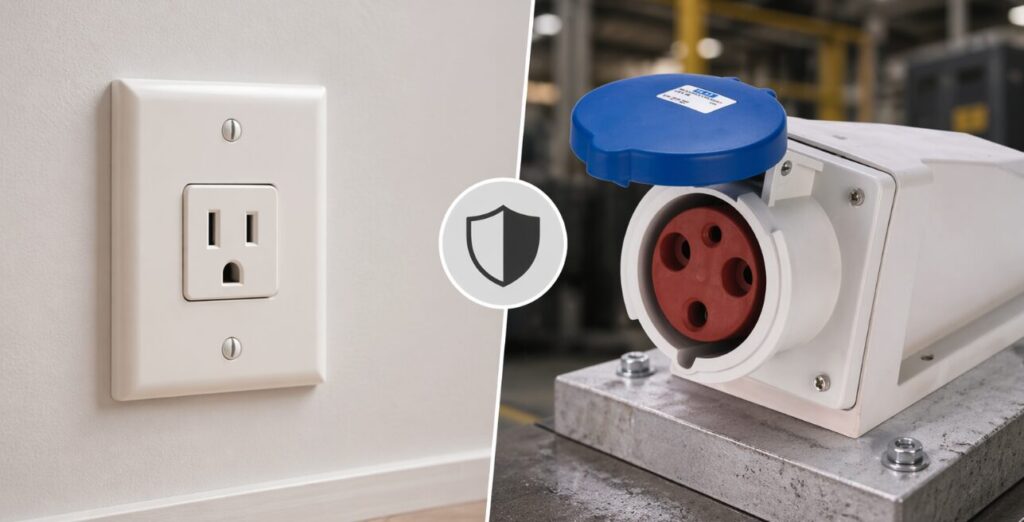
The human body is a conductor, and it doesn’t take much electricity to disrupt this physiological system.
Whether it is a 120V or 220V AC wall socket, it is absolutely capable of pouring deadly current directly into the human body. The human heart’s electrical rhythm is actually very fragile. If only a current of 50 to 100 mA is slightly stimulated, it will disrupt this rhythm and directly induce fatal ventricular fibrillation. At this extremely low threshold, the heart muscle does not pump blood normally, but begins to twitch wildly and irregularly, followed by rapid cardiac arrest. Standard sockets, originally designed for everyday household appliances, lack the rigorous physical protection required for high-risk applications, often leaving operators unguardedly exposed to this deadly milliampere threshold.
The Exponentially Magnifying Threat In Business And Industry
Standard sockets are dangerous enough in ideal indoor conditions, but the threat is multiplied if these already fragile sockets are misused in commercial and industrial environments.
Now running those heavy loads, large industrial machinery or rolled out new energy infrastructure requires continuous and absolutely no blind spot power transmission. It is extremely serious and systematic to save trouble on these huge energy loads and rely on standard or low-quality power connections. In this environment, the failure of wall sockets or ordinary plugs is more than just a spark or a gate. It directly paved the way for the following two hellish disasters:
- Catastrophic electric shock: As electricity demand multiplies, the voltage and amperage through the connections soar. In the event of accidental contact, its “explosion radius” and lethality also increase in a straight line.
- Serious facility fire: Ordinary sockets simply cannot withstand industrial-grade continuous current pulling. The crazy accumulation of heat caused by poor connections is often the direct cause of devastating electrical fires. If this fire starts, not only will the extremely expensive assets be wiped out, but the entire factory area will have to shut down.
How Harsh Environments Can Quickly Destroy Standard Sockets
The central reason why wall sockets can become deadly “killer” on industrial sites is the severe damage they cause by extreme environments. The standard power sockets used in normal use are designed for a well-controlled and static environment. If you really throw them into a real industrial operating environment, the speed of collapse is absolutely beyond imagination.
Site inspections not to overlook the following destructive forces:
- Invasation of moisture and dust: In industrial processing or outdoor new energy stations, moisture and conductive dust can easily get into the gaps of standard sockets. This is equivalent to creating an unexpected conductive path out of thin air, directly connecting the contacts over the bridge, and instantly lowering the insulation resistance below the danger line.
- Mechanical vibration: Heavy machinery is accompanied by continuous vibration as soon as it is turned on. Over the course of the day, this tremor can harden and loosen the previously compact plug and socket connections. As soon as the loose joint was fired (generating an arc), the outer plastic shell was melted directly by the high temperature, and the highly dangerous conductive wires were finally exposed.
- Sustained high current: Allowing high amperage current to flow through standard contacts will quickly cause thermal overload. When the contacts start to age and oxidize, the resistance will skyrocket, which in turn generates extremely high heat. At this point the standard enclosure simply wouldn’t hold up, melting away and triggering a catastrophic failure.
Eliminating Deadly Hazards: A Complete Shift To Industrial Power Outlets
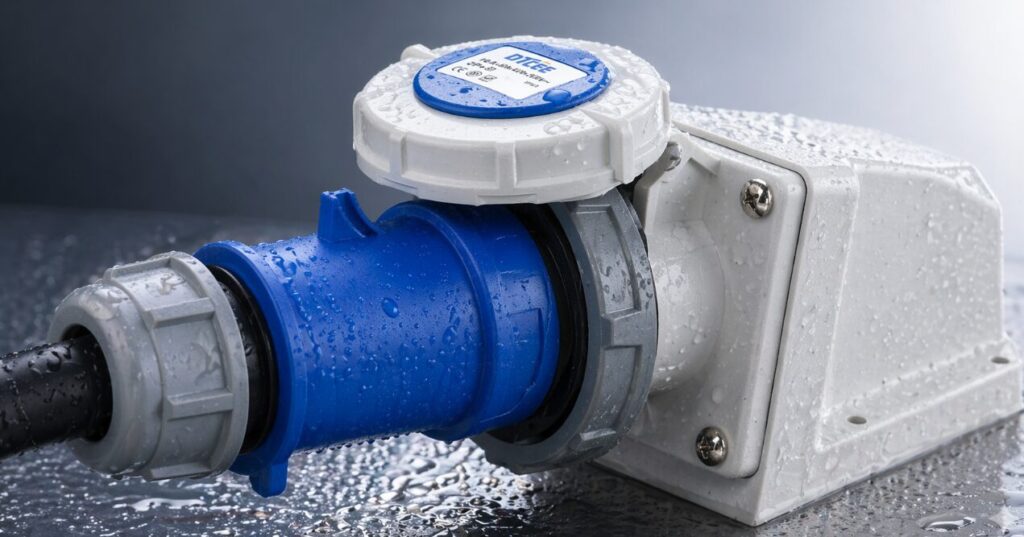
Absolute abandonment of traditional wall sockets in any heavy or commercial application. The most fundamental step in protecting human lives and preserving those millions of dollars worth of equipment is a complete upgrade to heavy-duty industrial sockets.
Especially in the sectors of globalized machinery and new energy, if we want to regulate safe power supply, we must mandate the use of components designed specifically for extreme operating pressures. The person who made the decision needs to keep an eye on it and make sure the industrial power connections used in your facility have the following hard indicators:
- Absolutely reliable connection guarantee: The industrial-grade locking mechanical structure can directly prevent the plug from accidentally falling off, which eliminates the arc ignition hazard caused by mechanical vibration.
- Top-level waterproof and dustproof seal: A shell with a high IP protection level like IP67 can completely block external moisture and dangerous dust, ensuring that the internal electrical resistance will never fall into the danger zone.
- Uncompromising safety compliance: High-end industrial contacts are built from highly conductive, high-temperature resistant materials. They are designed to withstand constant high currents without worrying about creating a dangerous thermal overload.
By replacing those vulnerable standard sockets with high-IP-rated heavy-duty industrial plugs and sockets, facility managers can truly minimize the fatal risks of power transmission and ensure undiminished safety and uninterrupted production in the world’s most demanding sites.
Author: Jack Lee
Hi, I’m a senior electrical project engineer with over 12 years of experience in industrial facility safety. I am passionate about eliminating these “ticking time bombs” from our industry and advocating for the mandatory use of heavy-duty, high-IP industrial power connectors to protect both human lives and expensive assets.