 datong


Do Sockets Use Electricity When Switched On
No. Without plugging into the standard socket of any device, there is absolutely no power consumption.
The reason behind this is that an empty socket is essentially an “open circuit” and there is no physical circuit for the current to flow through. So, even if you leave hundreds of empty outlets open throughout your workshop, you won’t get anything out of it “ghost energy consumption”, let alone any increase in your electricity bill. There is one minor exception: if the socket has an LED indicator, it does consume minimal standby power. The empty outlets is never really a problem and the real troubles on industrial sites are elsewhere. Leaving useless sockets open and exposing them directly to harsh industrial environments filled with dust and moisture can easily cause serious fires and equipment downtime.
Why “Socket Electricity Costs” Is A Pseudo-Proposition
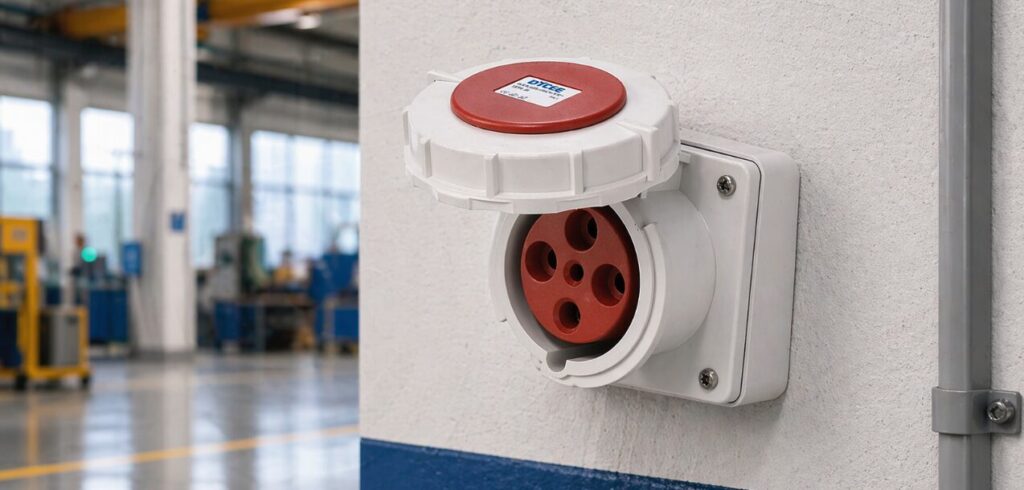
To figure out why an empty socket doesn’t consume power, we need to go back to the most basic circuit common sense. Power is the product of voltage and current. When an industrial socket is open but no machinery is connected, voltage does indeed apply to the terminals, but the current at this point is absolutely zero.
There is no plug to connect the bridge, and there is no way to get electricity. The management of many large manufacturing plants or new energy facilities stares at the so-called “ghost energy consumption” or “vampire electricity” every day. It must be made clear here that this hidden power consumption is caused entirely by devices that have been plugged into standby mode ——such as sensors, transformers or automation control panels on the machine—— and has nothing to do with the empty socket itself.
The Only Exception: LED Indicator
The only exception to the open-circuit rule is industrial sockets that come with their own LED status indicator. This design is quite common in some complex global mechanical configurations. After all, the operator can quickly confirm whether there is electricity at this point with a glance.
Because the LED light forms a tiny closed loop of its own, it does eat a little bit of electricity. But this consumes very little power —usually just a few watts per hour. Even in a super-large factory building with hundreds of lighted outlets, this power consumption is completely negligible. This is nothing compared to having clearly visible safety instructions in the workshop.
Environmental Hazards And Short-Circuit Failures
Since it is a myth that empty sockets consume electricity, the focus must return to the safety risks in heavy-load environments. This is a real threat. There is no point to stare at that nonexistent point “ghost electricity”; the real focus must be on the life-threatening environmental factors in new energy sites, chemical plants, or heavy industrial workshops.
If an empty socket is constantly powered, the terminals inside it are fully charged. Once exposed to harsh environments, an otherwise safe “open circuit” can easily be accidentally “closed” by pollutants in the environment.
- Moisture intrusion: Whether it’s a high-pressure water gun flush on the front line, rainfall from outdoor new energy equipment, or even ordinary condensation, it can get into the socket. As soon as water conducts electricity, it directly connects the live terminals.
- Industrial dust and impurities: Conductive particles floating in the air, metal debris, or heavy toner can easily deposit inside exposed sockets.
Once these impurities force a path for the current, a violent short-circuit explosion point follows. Not only can this instantly scrap the socket, but it also often causes large-scale equipment failure, resulting in extremely high losses due to power outages. Even more terrifying is the high risk of fatal electric shock accidents or electrical fires to surrounding workers.
Use High-Quality Industrial Sockets To Mitigate Risks
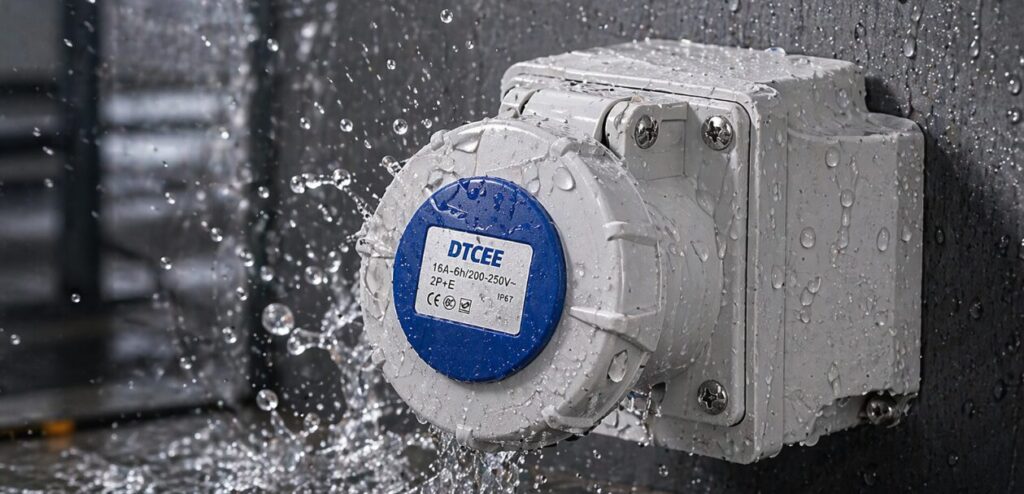
On a fast-paced industrial site, it’s not realistic to expect workers to turn off every unused power switch. The final solution to this problem still needs to start from the hardware level, that is, using a heavy-load industrial power connection solution that can withstand extreme environments.
To completely eliminate the risk of water and ash ingress into live terminals, industrial facilities must rely on sockets of high engineering standards. High-quality industrial power solutions are designed with various protective genes, including:
- High-standard IP protection level: High-level waterproof and dustproof housing (such as IP67 level protective housing) can ensure that even if the socket is always powered, water and conductive dust will never touch the internal contacts.
- Reliable protective cover: Spring-loaded or mechanically locked covers can automatically seal the socket after the plug is removed, which is the first physical barrier in harsh workshops.
- Durable housing and contacts: To cope with high-current applications (from standard equipment all the way to heavy-duty power needs like 63A or 125A), high-end sockets use impact-resistant materials and highly conductive, corrosion-resistant pins, which are the only way to maintain safety and efficiency during long-term operation.
All in all, you don’t need to worry about “whether the empty socket with the switch on will cost electricity”, but the strings must be taut at all times for safety hazards on site. Upgrading to weather-resistant, high-current industrial sockets as soon as possible will ensure that your power distribution system is truly safe and reliable, completely keeping out those harsh environmental hazards that cause real equipment failures.
Author: Mark Chen
Hi, I’m a senior electrical engineer with over 11 years of experience handling power distribution and safety cases on heavy industrial and new energy sites. My passion lies in uncovering the truth behind electrical setups and helping factories upgrade to weather-resistant, high-quality industrial sockets to ensure ultimate safety and zero downtime.