
 datong


European 220V Plug Wiring: 3 Phase & X/Y Terminals
Wiring a European 220V plug requires mapping the brown wire to the Line terminal, the blue wire to Neutral, and the green/yellow wire to Earth, strictly following the IEC 60309 standard. When handling 220v 3 phase plug wiring, technicians must terminate L1 (Brown), L2 (Black), and L3 (Grey) based on whether the grid is a standard 400V star system or a specific 230V IT grid. For those cross-wiring imported equipment, the x and y on 220v plug (standard in US NEMA connectors) designate two hot phase conductors, which creates a catastrophic voltage imbalance if blindly mapped to a European Line and Neutral terminal block.
You just wired a high-end European VFD using North American practices, powered it up, and blew the internal transformer. The mismatch between split-phase US grid logic and single-phase European design destroys millions of dollars in industrial equipment annually. We will break down exactly how to route european 220v plug wiring without frying imported machinery, utilizing field-tested mapping frameworks.
The Core Difference: European IEC vs. US NEMA 220V Mechanics
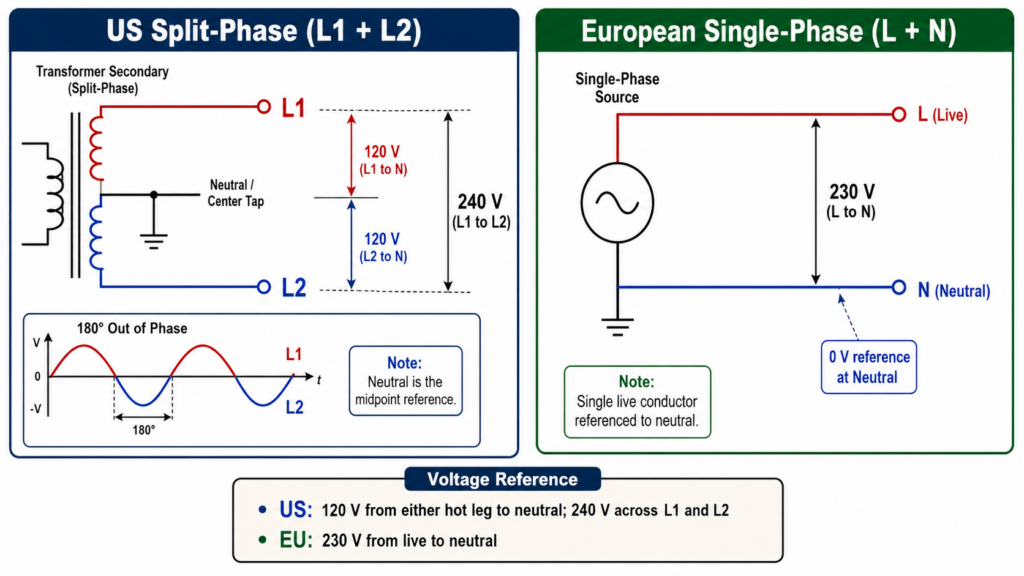
North American 220V/240V systems rely on two 120V hot legs out of phase by 180 degrees, whereas European 220V/230V systems utilize a single 230V hot wire against a 0V neutral. Engineers attempting to adapt a plug across these standards face immediate compatibility roadblocks.
Decoding X and Y on a 220V Plug
The X and Y terminals dictate the active hot conductors on a US-spec NEMA plug (such as the L6-20P or L6-30P). X and y on 220v plug connectors carry L1 and L2, each measuring 120V to ground. European plugs do not use X and Y nomenclature; they use L (Line), N (Neutral), and PE (Protective Earth). Mapping a US X terminal to an EU L terminal, and the Y terminal to an EU N terminal feeds 120V into the European neutral rail. This instantly degrades insulation and triggers ground fault errors on IEC-rated contactors. You must run a step-up transformer or a phase converter when driving European L/N components from a US X/Y supply.
How to Wire a 220V Plug with 2 Wires
Double-insulated appliances lacking a metal chassis bypass the grounding requirement entirely. Knowing how to wire a 220v plug with 2 wires involves terminating the active phase (Brown) to the ‘L’ pin and the return path (Blue) to the ‘N’ pin, leaving the Earth pin physically empty. This is standard for Class II European equipment (like heavy-duty power tools or specific CEE 7/17 ungrounded plugs). Operating any Class I metal-cased industrial gear with only two wires violates IEC 60364 safety protocols and risks lethal chassis electrification.
The C-P-T Protocol: Wiring European 220V Single Phase Plugs
We developed the C-P-T (Color, Phase, Terminal) protocol to eliminate guesswork when replacing damaged European cords. 220v single phase plug wiring depends entirely on isolating the reference voltage before stripping the jacket.
- Color: Identify the IEC color code. Brown is Live. Blue is Neutral. Green/Yellow is Earth. Black or Grey wires present in the cable indicate you are dealing with a 3-phase cord, not single phase.
- Phase: Verify the voltage with a true-RMS multimeter. Read L to N (expect 230V). Read N to PE (expect <2V).
- Terminal: Connect to the Schuko or IEC 60309 blue industrial plug. Secure the Green/Yellow wire to the center/bottom PE pin first. Secure Blue to ‘N’ and Brown to ‘L’ (usually indicated by brass-colored screws inside premium plugs).
European 220V Single-Phase Wiring Cross-Reference Chart
| IEC Wire Color | Phase / Function | Terminal Marking & Location | Expected Multimeter Value (True-RMS) |
| Brown | Live | L (usually brass-colored screws) | L to N: 230V |
| Blue | Neutral | N | N to PE: < 2V |
| Green/Yellow | Earth (PE) | PE (center/bottom pin) | (Reference point for Phase check) |
True 220V 3-Phase Plug Wiring (Industrial & IT Grid Specs)
European 3-phase power is predominantly 400V (Line-to-Line) with a 230V Line-to-Neutral reference. However, specific legacy grids demand an entirely different wiring approach.
The “Norway / Marine Grid” Exception
True 220v 3 phase plug wiring (where Line-to-Line equals 230V) exists almost exclusively in Norway’s IT grid systems and onboard commercial marine vessels. In these isolated networks, there is no Neutral wire. You terminate L1 (Brown), L2 (Black), and L3 (Grey) directly into a 4-pin (3P+E) blue industrial plug. Pushing 400V standard European 3-phase power into machinery rated for Norway’s 230V 3-phase IT grid causes immediate catastrophic overvoltage.
4-Pin vs. 5-Pin IEC 60309 Pinouts
Selecting the correct red or blue IEC 60309 connector dictates your terminal map.
- 4-Pin (3P+E): Used for 3-phase motors that do not require 220V single-phase control circuits. Terminate L1, L2, L3, and Earth.
- 5-Pin (3P+N+E): Mandatory for machinery containing PLCs or HMIs that run on single-phase 220V/230V. Terminate L1, L2, L3, Earth, and connect the Blue wire to the Neutral (N) pin. Leaving the N pin empty on a 5-pin system starves the control circuits of power.
Original Case Study: Retrofitting a German CNC VFD for the US Grid
Last year, our team consulted on a facility in Ohio that imported a German 5-axis CNC machine rated for European 230V single-phase. The internal maintenance team attempted to wire it by mapping the facility’s NEMA L6-20 240V supply directly to the machine’s IEC plug.
They connected US L1 to European ‘L’ and US L2 to European ‘N’. The CNC’s internal Siemens VFD used the Neutral as a 0V reference for its internal 24V DC switching supply. Hitting the European Neutral with a 120V AC offset (from US L2) instantly destroyed the logic board.
The Solution: We installed an isolation step-up/step-down transformer. We fed the US 240V (L1+L2) into the primary side. The secondary side was tapped to provide a true European 230V output (one 230V hot leg, one bonded 0V neutral). We then rewired the CNC’s plug following the single-phase C-P-T protocol. The machine has run flawlessly for 14 months without a single logic error.
People Also Ask (FAQs)
What do the X, Y, and Z terminals mean on a plug?
X, Y, and Z designate the active phase (hot) conductors in North American NEMA wiring. X and Y handle L1 and L2 in single/split-phase 240V systems, while Z carries L3 in a 3-phase system. They do not exist in European IEC standards.
Can I wire a 220V plug with only a black and white wire?
Yes, but only if the device is Class II double-insulated. You wire the black (live) to the L terminal and white (neutral) to the N terminal. You must never do this on a metal-cased appliance, as the lack of a ground wire poses a severe shock hazard.
What happens if I mix up L and N on a European 220V plug?
Schuko plugs are unpolarized, meaning L and N reverse depending on how you insert them into the wall socket. Appliances are designed for this. However, on polarized industrial IEC 60309 plugs, reversing L and N feeds live voltage to the neutral rail, breaking the switching logic of sensitive electronics and keeping internal circuits energized even when turned off.
How do I wire a 3-phase 220V European plug without a neutral?
Use a 4-pin (3P+E) plug. Strip the cable and secure L1 (Brown), L2 (Black), and L3 (Grey) to their respective phase terminals. Connect the Green/Yellow wire to the Earth pin. This configuration strictly supplies 3-phase power and cannot support 220V single-phase internal components.
Can I plug a European 220V device into a US 220V outlet using a simple adapter?
No. A simple physical adapter forces the US split-phase (two 120V legs) into the European device, which expects one 230V leg and a 0V neutral. This voltage reference error damages PLCs, timers, and VFDs. You need a dedicated voltage transformer.