 DTCEE



Schémas de câblage des prises industrielles et installation triphasée
Wiring industrial sockets is no laughing matter. Whether according to IEC 60309 or NEMA standards, L1, L2, L3 (three live wires), neutral wire (N) and ground wire (PE) must be seated in a tight fit. As long as two of the phase lines are reversed in the three-phase socket, the steering of the motor will immediately reverse-this can directly destroy the heavy industrial water pump or compressor at the moment of startup.
Today, I will shred the wiring details of the three-phase industrial socket to everyone. Incidentally, I will talk about the doorway of terminal tightening torque and teach you how to ensure that you are safe and completely bid farewell to potential safety hazards such as joint overheating and even arc explosion.
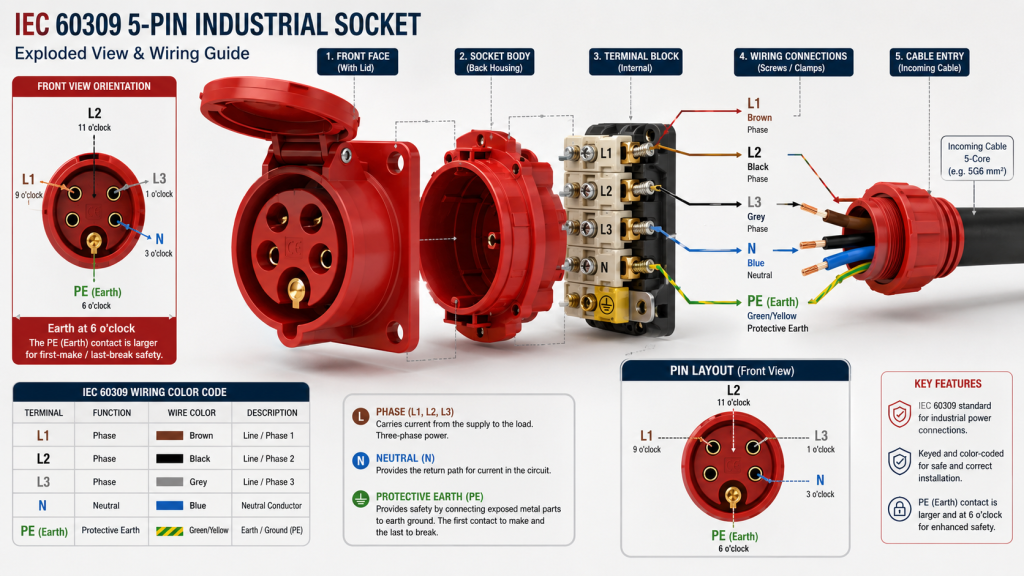
Three-Phase Industrial Socket Wiring Diagram (IEC 60309 Standard)
The letter logo on the terminal is the “baton” of our construction “. Standard three-phase systems are usually divided into 4-core or 5-core sockets according to equipment requirements.
- 4-pin socket (3P E): This device is specially designed to supply power to pure three-phase loads, such as heavy-duty motors or electric welding machines with triangular connection.
- L1 terminal: brown wire (first phase).
- L2 terminal: black wire (second phase).
- L3 terminal: gray line (third phase).
- E (ground) terminal: connected to yellow-green double-color wire. (You will find that this pin is physically thicker and longer than the others, in order to ensure the safety mechanism of “grounding first and breaking the ground later”).
- 5-core socket (3P N E): if it is a star-type (y-type) connection equipment, it needs 400V main power supply to run the machine, and 230V auxiliary circuit to handle the control panel or lighting, then it must be equipped with 5 cores.
- The connection method of L1, L2, L3 and ground is exactly the same as before.
- N (zero line) terminal: connected to the blue line.
| Socket Amp Rating | Required Wire Cross-Section (mm² / AWG) | Terminal Torque Specification (Nm) | Recommended IP Rating (Indoor vs Outdoor) |
| 16A | 1.5 – 4.0 mm² / 14 – 12 AWG | 0.8 – 1.2 Nm | Indoor: IP44 / Outdoor: IP67 |
| 32A | 2.5 – 10.0 mm² / 12 – 8 AWG | 1.2 – 1.8 Nm | Indoor: IP44 / Outdoor: IP67 |
| 63A | 6.0 – 25.0 mm² / 8 – 4 AWG | 2.0 – 2.5 Nm | Indoor: IP44 (or IP67) / Outdoor: IP67 |
| 125A | 16.0 – 50.0 mm² / 4 – 1/0 AWG | 3.5 – 4.0 Nm | Indoor: IP67 / Outdoor: IP67 |
The “Core (C.O.R.E.)” Rule For Industrial Socket Installation
Accidents on site are often caused by the installation master ignoring the environmental protection level or not screwing the screws to the specified torque. In order to ensure that the socket will not fall off the chain under severe vibration environment, I strictly abide by the C.O.R.E. rule every time I construct:
- C – Configuration (configuration matching): Look at the equipment under the dish. Although the machine has only a 4-core wire, you have to match it with a 5-core socket. Not to mention blindly changing the power cord plug, which will directly damage the grounding design of the equipment itself.
- O-Overcurrent (wire diameter overload prevention): wire thickness must match the rated current of the socket. The 16A socket is honest and practical with 2.5 square (mm) wires, 32A with 6 square, 63A with 16 square.
- R-Routing (phase sequence direction): maintain a clockwise phase sequence connection (L1-L2-L3) on the terminal to ensure that the standard motor rotates forward.
- E-Earth (ground clock position): Check the “clock position” of the ground pin to confirm the voltage level. For example, the red socket of the ground hole at 6 o’clock (6h) is 380-415V, and the blue socket at 9 o’clock (9h) is 200-250V.
Hard Core Wiring Practice: Details Determine Success Or Failure
Never put the bare copper multi-strand cord directly into the terminal and tighten it. The time is 1 long, the copper wire is flattened and loosened by the screw, the contact resistance becomes larger, and the socket shell is quasi-heated. To deal with multi-strand flexible wires, insulated tube type cold-pressed terminals must be punched.
- Stripping wire and sleeve terminal: accurately peel off 15mm insulation. Straighten out the spread copper wire and plug it into a tube terminal of appropriate size.
- Crimping: use ratchet crimping pliers to tightly press the terminal. The hexagonal crimping surface and the round socket terminal hole match best, which can maximize the contact area.
- Connect the three-phase live wire: insert the pressed wire ends into L1, L2 and L3 in turn. Tighten with a torque screwdriver according to the manufacturer’s standard — 16A socket is generally 1.2 Nm,32A is about 2.5 Nm. Something will happen sooner or later if you twist blindly with your hand.
- Fix the ground wire and the zero wire: always ground the wire first. If you are connected to a 5-core socket, connect the ground wire and then connect the neutral wire.
- Lock the tail Gram head: firmly tighten the cable waterproof connector (gland nut) at the tail of the socket until the rubber ring inside slightly squeezes the cable sheath to a bulge. This step is done, the socket can really reach the IP44 or IP67 protection standards, completely prevent dust and water vapor run in.
Old Hand Pit Avoidance Guide: “Clock Point” Anti-Stay Design And Mechanical Linkage
The most common failure on site is mostly due to the maintenance personnel trying to put the mismatched plug into the socket. The IEC 60309 standard is very clever with a “dial clock” system to arrange the position of the ground pin, which is actually physical anti-stunned.
The red 400V socket has the ground pin fixed at 6 o’clock (6h); The blue 230V socket has the ground hole at 9 o’clock (9h). And the main positioning keyway of the shell is always at 6 o’clock. In other words, you can’t plug a 230V plug into a 400V socket. Don’t push the plastic positioning groove flat and hard to insert it in order to save trouble. It is a joke of life.
Now, the latest arc protection safety standards like NFPA 70E strongly recommend that factories use sockets with mechanical interlock switches. This thing has a physical switch on the surface. The switch cannot be opened until the plug is completely plugged in. As long as the switch is still powered on, the plug cannot be pulled out anyway. This completely eliminates the danger of a fatal arc when the plug is pulled.
Blood And Tears Case: Massacre Caused By Blow Of 63A Socket Zero Line
In a three-phase star (Y-type) system, if the neutral line is loosened, the voltage imbalance caused is absolutely devastating.
Once I went to a CNC machine processing factory to check the line and found that a 63A 5-core industrial socket had completely melted down and the 230V control board of a CNC machine tool had been burned completely. Through thermal imaging and disassembly analysis, we found that the culprit was that the installer did not tighten the neutral terminal (the measured torque was only 0.8 Nm, while the standard requirement was 3.0 Nm).
When this machine pulled an unbalanced single-phase load, the loose neutral wire connector produced a huge resistance, causing the terrible “zero drift”. As a result, the voltage of one phase dropped directly to 170V, while the other 1 phase instantly soared to 290V. It is this high voltage of 290V that breaks down the CNC control board. Later, we replaced all the sockets of the whole line with a spring clip type (screw-free). This design can bite the wire tightly regardless of thermal expansion and contraction or factory machine vibration.
FAQ
Q: What is the wiring of a 5-core three-phase industrial socket?
Answer: A total of 5 wires are connected: 3 live wires (brown to L1, black to L2, gray to L3), 1 zero wires (blue to N), and 1 ground wires (yellow and green double color wires, connected to the thickest ground wire pin).
Q: What if L1 and L2 are connected backwards?
Answer: Changing two phase lines casually will directly change the phase sequence. The three-phase motor plugged into this socket will reverse, and the mechanical transmission system, water pump impeller or hydraulic pump will be scrapped with high probability.
Q: What does the “6h” on the red socket mean?
Answer: “6h” means that when you are looking at the socket, the ground hole is located at 6 o’clock (the main locating groove is directly below). This position is the identity mark, indicating that this is a 380V-415V level component.
Q: Can I hard plug the 4-pin plug into the 5-pin socket?
A: Absolutely not. IEC 60309 standard plug and socket in the number of pins and voltage have done a strict anti-dumb. The 4-core plug cannot be plugged into the 5-core socket at all, which avoids the fatal risk of the equipment leaking the zero line or ground line.
Q: What is the difference between IP44 and IP67 sockets?
Answer: IP44 is splash-proof, it is enough to put it in the indoor workshop. IP67 is completely dustproof and can be soaked in water for a short time. If it is outdoor, an area requiring high-pressure water gun washing, or a dock, IP67 must be used compulsorily.
Q: Do I have to use cold-pressed terminals (line nose) to connect industrial cords?
Answer: It is necessary. If the multi-strand soft copper wire is not set with terminals, the thin copper wire inside will spread out or even break when the screw is screwed. This can lead to poor contact, hot spots, and ultimately arc faults.