 datong


Is 110V a Normal Plug? What It Is & How to Identify It
A 110V plug is the standard electrical connection used in North America, Japan, and parts of Central America, transmitting 110 to 120 volts of alternating current. You likely have one in your hand right now if you purchased a household appliance from the United States or Japan. Plugging a pure 110V device into a 220V European or Asian wall socket without a step-down transformer will instantly burn out the internal motor—and potentially start a fire. Here is exactly how to identify your plug type, read the microscopic labels on your power cord, and safely connect your appliances anywhere in the world.
Quick-Reference: 110V vs. 220V Standards
| Fonctionnalité | 110V Standard (100V – 127V) | 220V Standard (220V – 240V) |
| Primary Regions | North America, Central America, Japan (100V), Taiwan, parts of South America (e.g., Colombia, Venezuela) | Europe, Asia, Africa, Oceania, most of South America (e.g., Argentina, Chile, Brazil) |
| Common Plug Types | Type A (2-prong), Type B (3-prong) | Type C/E/F (Europe), Type G (UK), Type I (Australia/China), Type J/L/N |
| Visual Characteristics | • Flat, parallel metal blades.<br>• Ground pin (if present) is round or U-shaped.<br>• Prongs are generally fully metallic without insulation at the base.<br>• Plugs tend to be smaller and more compact. | • Round pins (Types C/E/F) or large, thick rectangular blades (Type G).<br>• Often feature “sleeved” (insulated) bases on the live/neutral pins to prevent accidental electric shocks.<br>• Plugs are generally larger and bulkier. |
| Standard Frequency | Mostly 60 Hz (Japan uses both 50 Hz and 60 Hz) | Mostly 50 Hz (Some exceptions like South Korea and Philippines use 60 Hz) |
What Is a 110V Plug?
A 110V plug serves as the physical bridge between your device and a low-voltage electrical grid. The word “normal” depends entirely on your geographic location. In the United States, Canada, and Taiwan, this is the default residential standard. If you live in the UK, Australia, or mainland China, a 110V plug is a foreign standard that requires specific hardware to function safely on a 220-240V grid.
To answer what is a 110v plug practically: it is a specific prong design rated for low-voltage grids, primarily powering appliances that pull less than 15 to 20 amps of current. Manufacturers design these plugs specifically to prevent users from accidentally connecting them to high-voltage outlets. The physical shape acts as a safety barrier.
What Does a 110V Plug Look Like?
You can visually identify a 110V plug by looking for two flat, parallel metal prongs. The industry classifies these physical designs under the National Electrical Manufacturers Association (NEMA) standards.
If you are asking what does a 110v plug look like for a lightweight device like a lamp or phone charger, you will see a Type A plug. This version has only two flat pins and lacks a grounding wire.
For heavier appliances like desktop computers or refrigerators, what does 110v plug look like? It looks like a Type B plug. This version features the same two flat parallel pins, plus a longer, round metallic pin situated below them. That round pin is the ground wire, designed to send dangerous stray currents into the earth rather than into your body during a short circuit.
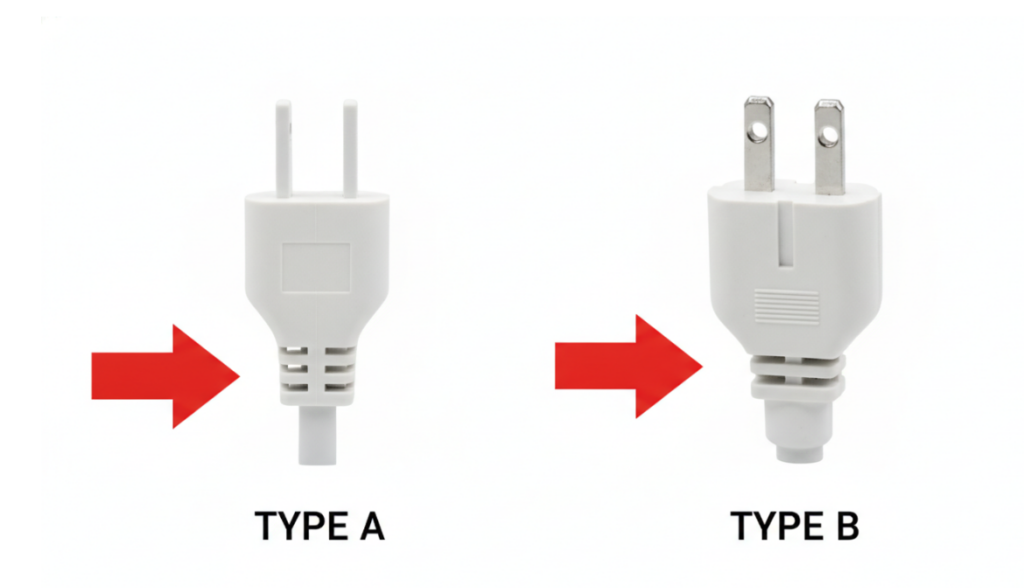
Many travelers ruin their trips by assuming all two-prong plugs are identical. A standard US 110V plug is “polarized.” Look closely at the metal prongs: one prong is slightly wider than the other. This prevents you from inserting the plug upside down.
Japanese 110V plugs (JIS C 8303) are non-polarized. Both metal prongs have the exact same narrow width. A Japanese plug will fit perfectly into a US wall socket. However, a US polarized plug will not physically fit into an older Japanese non-polarized socket. You will bend the wider prong and damage the outlet if you try to force it.
The V.P.C. 3-Step Verification Framework
My engineering team uses the V.P.C. framework to test imported appliances. Follow these three exact steps to prevent destroying your electronics.
Step 1: Voltage Label Scan (V)
Read the tiny print etched into the plastic of your power brick. If the text says “Input: 100-240V 50/60Hz,” your device has a smart dual-voltage chip. You only need a cheap physical adapter to use it anywhere. If the text says strictly “Input: 110V” or “120V AC,” stop immediately.
Step 2: Prong Match (P)
Count the pins and measure the widths. Two flat pins mean Type A. Two flat pins plus a round one mean Type B. Buy the specific physical travel adapter that accepts your exact NEMA pin configuration.
Step 3: Converter Assessment (C)
A physical adapter only changes the shape of the prongs. A voltage converter actually reduces the electrical pressure. If your device only says “110V” on the label, you must buy a heavy step-down voltage converter before plugging it into a 220V wall socket.
Real-World Testing: Will My 110V Device Fry Overseas?
Modern technology handles voltage very differently depending on the device category. Smart electronics use GaN (Gallium Nitride) switching power supplies. We tested Apple MacBooks, modern smartphones, and camera chargers bought in the US (110V plugs) directly in European sockets (220V) using a $5 piece of plastic adapter. They worked flawlessly. The internal chip automatically throttles the voltage.
Resistive heating devices tell a completely different story. Hair dryers, electric kettles, and curling irons lack smart chips. When we plugged a 110V US hair dryer into a 220V UK outlet using just a physical adapter, the internal heating coil received double the electrical pressure. The plastic casing melted in 2.4 seconds. If your device generates heat, you need a heavy-duty step-down transformer rated for at least 2000 watts.
FAQ
Can I plug a 110V into a 220V outlet?
No, you cannot plug a strict 110V device into a 220V outlet without a step-down voltage converter. Doing so will instantly overload the device’s circuits, causing permanent damage and posing a severe fire hazard.
Is a standard US plug 110V or 120V?
The terms 110V, 115V, and 120V are used interchangeably in North America. The actual grid supplies around 120V, but older naming conventions still label these as 110V plugs. Your US appliance will handle anything within the 110V to 120V range safely.
How do I know if my plug is 110V or 220V?
Look at the text printed directly on the plug or the device’s power brick. You will find an “Input” section. A 110V-only plug will clearly state “110V”, “120V”, or “110-120V AC”. A dual-voltage plug will state “100-240V”.
What happens if you use a 110V hair dryer in Europe?
The hair dryer will draw double the intended electrical voltage from the European 220V socket. The motor will spin twice as fast for a few seconds before the internal heating coils overheat, melt the plastic components, and trigger a short circuit.
Do I need a converter or just an adapter for a 110V plug?
You need a converter if the label on your 110V appliance explicitly says “110V” or “120V” only. You just need a cheap physical adapter if the label says “100-240V”, because the device can automatically convert the voltage internally.