 datong


Types Of 220v Plugs In Us: Which One Do You Actually Need?
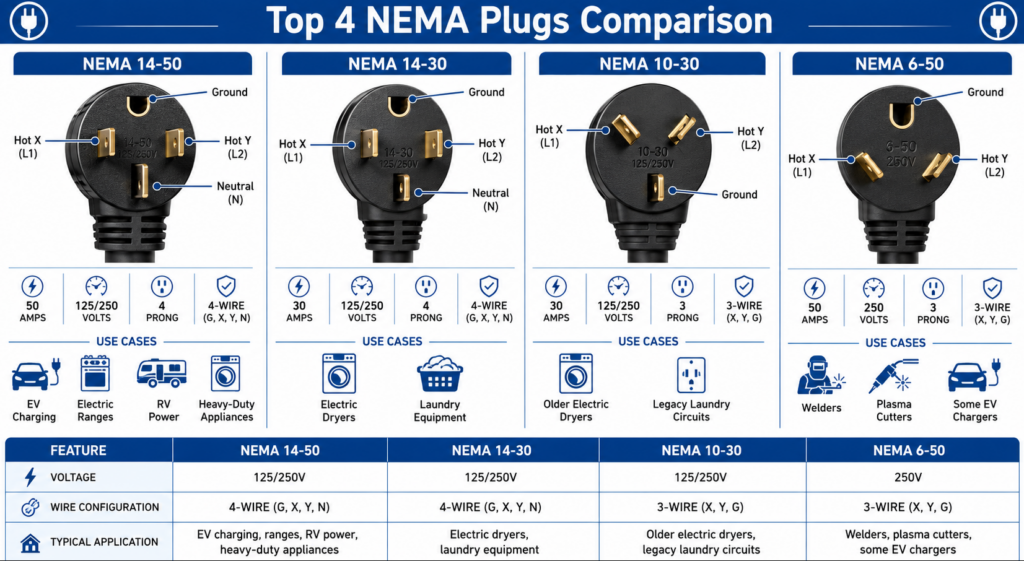
In the United States, dealing with high-power 240V (commonly referred to as 220V) household appliances inevitably brings you face-to-face with four main plugs: NEMA 14-50 (commonly used for EVs and ovens), NEMA 14-30 (newer dryers), NEMA 10-30 (older dryers), and NEMA 6-50 (specialty garage equipment like welders). Which one you need depends entirely on the appliance’s amperage (current) requirements and whether the wiring in your wall includes a neutral wire.
Many people try to cut corners by simply buying an adapter online, attempting to force a newly purchased 4-prong dryer plug into an old 3-prong wall outlet. Stop right there! If you use the wrong adapter for these high-voltage appliances, the neutral current can be directed straight to the appliance’s metal chassis. In the event of a short circuit, touching the dryer could result in a fatal shock. Today, we are going to take a deep dive into how to correctly choose a 240V plug in the US to ensure your home’s electrical safety and absolute compliance with electrical codes.
The “V.A.W.” Rule: 3 Steps to Precisely Match Your Appliances
When electricians categorize high-power outlets, the underlying logic is actually very simple. You don’t need to memorize a bunch of professional jargon; just apply this “V.A.W.” (Voltage, Amperage, Wires) formula, and you can easily navigate US 240V plugs.
- Voltage (V): We are dealing with 240V (what we often colloquially call 220V). This immediately rules out all standard NEMA 5 plugs (the most common 120V, 3-prong standard household outlets).
- Amperage (A): Check your appliance’s nameplate. Dryers typically require 30 amps, while EV charging stations and large electric ranges generally require 40 to 50 amps. The plug’s rated current (the last digits in the NEMA code) must match the limit of your circuit breaker.
- Wires (W): Does your appliance need 120V to power an electronic display or timer while simultaneously running a 240V heating element? If so, it requires 1 neutral wire (meaning a 4-prong plug is required). If it only uses power to generate heat or drive a motor and doesn’t need a 120V supply at all, the neutral wire can be omitted (meaning only a 3-prong plug is required).
| V.A.W. Factor | What to Check | Common Options | Recommended Plug Configuration |
|---|---|---|---|
| Tension (V) | Confirm the appliance operating voltage on the nameplate | 240V (commonly called 220V) | Use a 240V-rated plug; do not use a standard 120V household plug |
| Amperage (A) | Check the appliance’s current draw and circuit breaker rating | 30A, 40A, 50A | Select a plug with the same amperage rating as the circuit |
| Wire Count (W) | Determine whether the appliance requires a neutral conductor | 3-Wire: Hot, Hot, Ground4-Wire: Hot, Hot, Neutral, Ground | Use a 3-prong plug for 240V-only loads; use a 4-prong plug when both 120V and 240V are required |
| Typical 30A Application | Clothes dryer | 240V / 30A | 4-prong (modern installations) |
| Typical 40A Application | Electric cooktop or range | 240V / 40A | 3-prong or 4-prong depending on appliance requirements |
| Typical 50A Application | EV charger, large electric range | 240V / 50A | Usually 4-prong when a neutral is required |
The 4 Most Common Categories of 240V Plugs in the US
The National Electrical Code (NEC) standardizes these outlet connections under the NEMA (National Electrical Manufacturers Association) system. Let’s break down the configurations you are most likely to encounter.
NEMA 14-50 and 14-30 (The Modern Standards)
The NEMA 14 series is the absolute workhorse for high-power residential appliances in the US today. They all feature a 4-prong design: two hot wires, one neutral wire, and a dedicated safety ground wire.
- NEMA 14-50 (50 Amp): The heavyweight. Used for large kitchen electric ranges, RV park external power supplies, and home Level 2 EV charging stations.
- NEMA 14-30 (30 Amp): Every dryer manufactured since 1996 comes standard with this plug. Its L-shaped ground pin is cleverly designed to prevent you from accidentally plugging a 30-amp dryer into a 50-amp circuit.
NEMA 10-30 and 10-50 (The Outdated, Risky 3-Prongs)
Prior to 1996, electrical codes allowed appliances to be grounded directly through the neutral wire. As a result, even though the NEMA 10 series has 3 prongs, it lacks an independent safety ground wire.
- If you live in an older house, there’s a high probability you have a NEMA 10-30 outlet in your laundry room. However, modern building codes prohibit the installation of new NEMA 10 outlets. If you buy a new dryer with a 4-prong cord (14-30), the correct and legal solution is to remove the factory 4-prong cord, replace it with a 3-prong cord (10-30), and properly bond the ground to the chassis at the back of the machine according to the manufacturer’s instructions—rather than buying a highly unreliable plug adapter online.
NEMA 6-20 and 6-50 (Pure 240V, No Neutral)
The NEMA 6 family provides pure 240V power without a neutral wire. These are also 3-prong plugs (two hot wires, one ground wire).
- NEMA 6-50: The standard for heavy garage equipment (e.g., welders, air compressors). Because these machines lack 120V electronic clocks or control boards, they don’t need a neutral wire at all.
- A Note for Overseas Buyers: If you bring a pure 220V/240V appliance from Europe or China (like a high-end Italian espresso machine) that doesn’t require a US neutral wire, hiring an electrician to install a NEMA 6-20 outlet is the safest and most code-compliant way to run it in the US.
The “Adapter Trap”: Why Online Shopping Adapters Easily Cause Fires
DIY enthusiasts are the most likely to fall into the “old house outlet, new appliance” trap. A quick online search will yield thousands of “3-prong to 4-prong dryer adapters.”
Recent tests on 20 cheap adapters sold by third-party sellers revealed a terrifying truth: over 80% use a “bootleg ground.” Inside the adapter, the ground pin of the new appliance is wired directly to the neutral pin of the old outlet. The neutral wire connections in older homes’ electrical panels are prone to aging and loosening. If a poor connection occurs, the return current will flow directly onto the appliance’s metal chassis.
Take this advice: Do not buy these plug adapters. The correct procedure is to purchase a pigtail power cord that matches your wall outlet, wire it to the back of the machine, and connect the chassis ground strictly following the appliance’s electrical manual.
The Reality of EV Charging: Why Are People Abandoning NEMA 14-50 for Hardwiring?
If you’ve been researching 240V plugs to charge your EV (like a Tesla or Ford EV), you might think installing a NEMA 14-50 outlet is the ultimate solution. However, the latest electrical codes are signaling a shift.
According to the 2020 and 2023 NEC updates, any 240V receptacle installed in a garage must have Ground-Fault Circuit Interrupter (GFCI) protection at the breaker. What’s the problem? High-quality EV charging stations on the market already have built-in GFCI protection.
In field tests of home EV charging stations, a vast majority of owners using NEMA 14-50 outlets experienced “nuisance tripping.” The GFCI in the breaker panel and the GFCI in the charger conflict with each other, causing the car to inexplicably stop charging in the middle of the night.
The Expert Solution: Have your charging station “hardwired” directly into the electrical panel. Hardwiring perfectly bypasses the NEC requirement for garage receptacle GFCI, completely eliminating the headache of nuisance tripping. Furthermore, hardwiring allows you to push the charging current up to 48 amps, whereas plug-in models are typically capped at 40 amps.
FAQ
What is the actual voltage of a “220V” outlet in the US?
The actual voltage provided by the US residential power grid is 240 volts (combining two 120-volt hot legs). In everyday conversation, the terms 220V, 230V, and 240V are used interchangeably, but the modern NEMA outlets on your wall physically output 240 volts.
Can I plug 220V appliances brought from China/Europe directly into a US 240V outlet?
No, you absolutely cannot. First, the pin shapes are completely different. Second, the grid frequency in China and Europe is 50Hz, while in the US it’s 60Hz. Even if you use a physical adapter and force it into a NEMA 6-15 or 6-20 outlet, motorized appliances (like high-speed blenders or hair clippers) will run 20% faster, which can easily burn out the motor. Pure heating appliances, like electric kettles, will usually survive.
Why does my 240V plug have 4 prongs instead of 3?
That extra prong is a dedicated safety ground wire. The outdated 3-prong 240V plugs (NEMA 10 series) combined the functions of the ground and neutral wires, posing a serious risk of electric shock. For safety reasons, the US mandated in 1996 that all newly installed dryer and electric range outlets must use 4-prong plugs (NEMA 14 series).
Can I just replace the 3-prong 240V wall outlet with a 4-prong outlet?
Don’t think replacing a plastic faceplate solves the problem. If you want to upgrade from 3 prongs to 4 prongs, you must hire a licensed electrician to run a brand-new 4-wire cable from your main electrical panel all the way through the walls to the outlet.
For EV charging, is NEMA 6-50 better than 14-50?
In terms of installation cost, NEMA 6-50 is indeed cheaper because it only requires running three wires (saving money on a thick, expensive copper neutral wire), and most EV chargers don’t need a neutral. However, the 14-50 is far more versatile. If you sell your house in the future, the next homeowner can use the 14-50 outlet to power an RV or heavy-duty power tools. Long-term, the 14-50 is a better investment.