 DTCEE



220v Air Compressor Plug: What To Verify Before Buying
When the original air compressor plug is damaged, or when new equipment arrives but there is no suitable connector, many people will first look at the nameplate “220V” and then find a plug with a similar appearance. Here’s the problem: 220V only describes some of the electrical conditions, but it doesn’t specify whether the device is single-phase or three-phase, how many current-carrying conductors are needed, or the rated current or interface location.
Therefore, the 220v air compressor plug is not a complete specification that can be ordered with just one purchase. A truly usable replacement part must match the device, power supply, cables, protective device, and the socket on the other side.
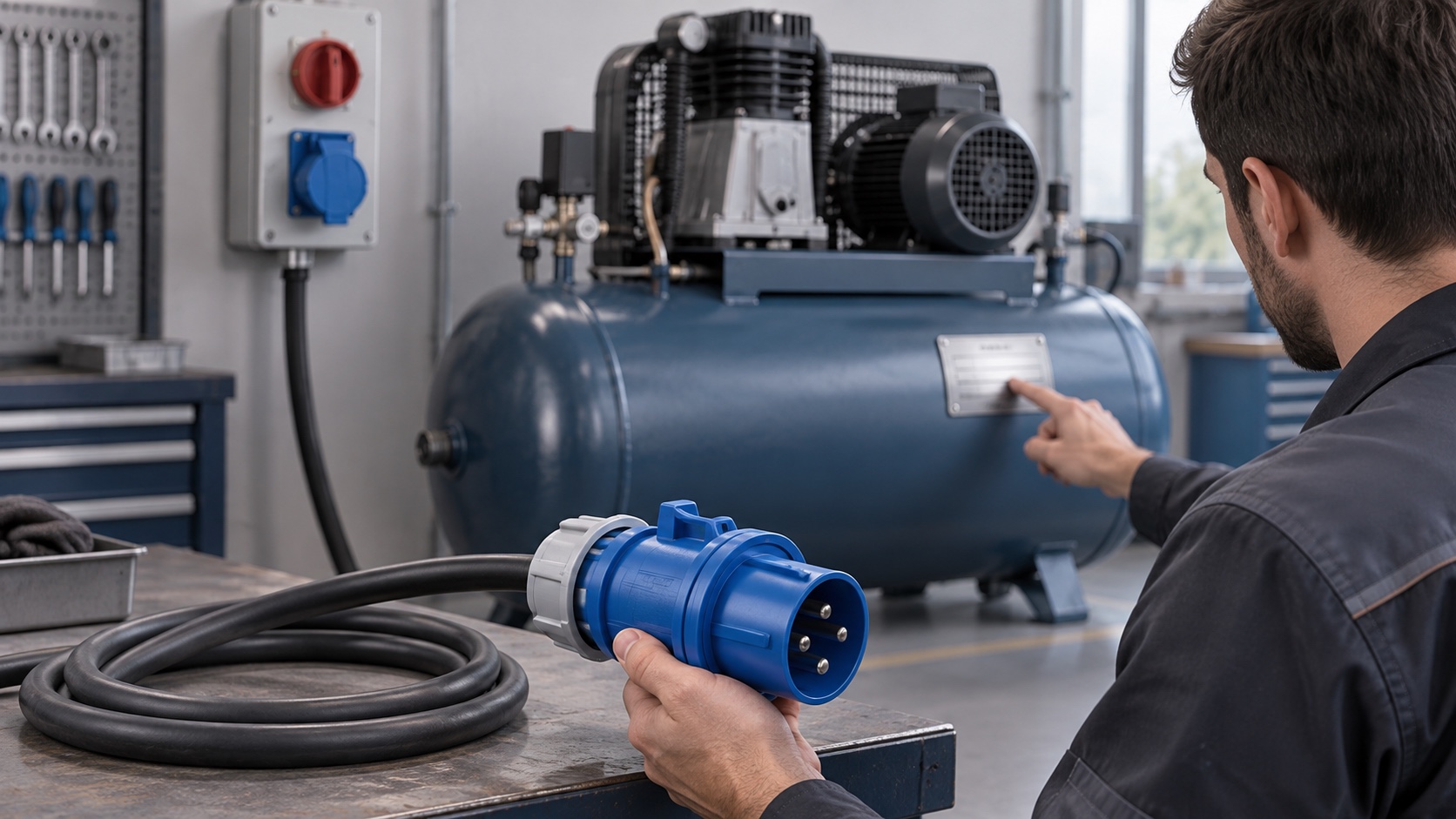
Copy the Information on the Nameplate and Wiring Diagram First
Do not guess the current from the size of the compressor or the appearance of the motor. First, record the permissible input voltage, frequency, single-phase or three-phase, rated current, and whether the wiring diagram requires a neutral wire and a protective conductor. Electric motors may also have starting current and operating requirements. Simply dividing the mechanical output power by the voltage does not produce reliable plug specifications; equipment nameplate current or design current determined by professional design is more suitable as a starting point.
It also depends on the on-site power supply, not just the equipment itself. The fact that a device allows the use of a certain voltage does not necessarily mean that the existing circuit will provide the correct phase, frequency, grounding method, and available current. If the equipment does not match any of the power supply conditions, the power supply solution should be addressed first, rather than connecting the two ends with an adapter.
Change “a Few Stitches” to the Official Pole Position
Three-needle, four-needle, and five-needle descriptions are for appearance, and should be further written as 2P+E, 3P+E, or 3P+N+E when purchasing. 2P+E contains two current-carrying poles and a protective conductor contact; 3P+E is used for three phase conductors plus a protective conductor and does not contain a neutral conductor; 3P+N+E has an additional neutral conductor.
The name “air compressor” itself cannot determine which type to use. The phase number should be confirmed according to the nameplate, wiring diagram and field power supply, and it should be determined whether the load uses the neutral wire. Neutral conductors and protective conductors perform different functions and cannot be interchanged to make up the number of contacts.
The Current Gear Must Be Coordinated with the Entire Loop
The rated current on an industrial plug is the design load-bearing level of the accessory under specified conditions. It is not equal to the actual current always consumed by the air compressor, nor does it prove that the upstream circuit can necessarily provide the same current. When selecting a gear, you must simultaneously check the load design current, cable current carrying capacity, terminal allowable range, upstream protection device, and starting conditions.
When using the IEC 60309 interface, the specification series must also be clearly defined. Series I typically uses ratings such as 16 A, 32 A, 63 A, and 125 A, while Series II uses ratings such as 20 A, 30 A, 60 A, and 100 A. A close number does not indicate the same size or interface. Installing larger plugs onto smaller cables or loops will not increase the permissible load on the cables, protective devices, or equipment.
The Blue Casing Can Only Be Used for Preliminary Verification
In the common color coding of IEC 60309, 220V, 230V and 240V products usually fall within the blue recognition range of 200V to 250V. However, blue cannot be used to independently determine specific voltage, phase, current level, or protection level.
In common 50 Hz or 60 Hz configurations, the 2P+E, 200V to 250V accessories use the 6h position, and the 3P+E, 200V to 250V accessories use the 9h position. Even if the two are the same color, they cannot be interchanged. When checking existing sockets, compare the standard system, rated current, pole position, voltage range, frequency, clock position, key position, and contact arrangement item by item. Stop when it won’t plug in. Do not cut the key, modify the contacts, or force it in.
Confirm That You Bought a Plug
The plug is the accessory that connects the flexible cable and has pins. A portable socket that connects to a flexible cable but has a jack; a socket that is fixed to the equipment and has pins is considered an appliance input socket. The “male ”“ female” designation on the business page may ignore the installation role. It is best to let the supplier clearly specify the pins or jacks, flexible cable end or fixed end, and provide a recommended pairing model.
When replacing the original accessories, first record the complete model of the original plug, and then take a picture of the front of the other interface, the nameplate and the clock mark. Similar outer diameters, the same color, and even the ability to be mechanically plugged in and out are not sufficient to prove that the electrical configuration and protection status are correct.
Finally Check Cables, Environment and Installation Status
The moving cable end also needs to check the cable outer diameter, core number, conductor cross-sectional area, inlet seal, and stress relief structure. The tension and torque should be borne by the clamping structure and cannot be directly transmitted to the terminal blocks. On-site conditions such as moisture, dust, oil, drag, or mechanical impact must also be assessed separately; IP rating cannot replace the judgment of material and mechanical suitability.
Wiring should be completed by qualified electrical personnel in accordance with the specific model description and local rules. Isolate the power supply before operation and prevent accidental power supply. After connection, check the protective conductors, terminal fastening, cable fixing, sealing and locking mechanisms. The final procurement specifications should at least answer these questions: what standard to use, how many amps, what voltage and frequency, what phase and pole position, which clock position, pin or jack, what protection status is required, and which model to pair with. If there is one item missing, please fill in the information before placing an order.