 DTCEE



220V Power Plug Types: Identify All AC Plug Types Now
The 220V AC plug is responsible for connecting electrical appliances to the 220-240V power grid. At present, the most common type in the world is C, E, F, G or I, while the heavy-duty electrical appliances in North America are dedicated to NEMA 6 series. Honestly choosing the right 220V power plug can help you avoid the bad luck of melting, tripping or even burning electrical appliances.
Many strategies on the Internet are to list the to N plugs 1 randomly, and the rest depends on your own guess. The result? Every day, countless high-power imported hair dryers and coffee machines are scrapped because of indiscriminate insertion. This article is not empty. It directly gives you the most hard-core engineering science, district standards and safety limits, and teaches you how to safely match your equipment.
V-P-A Pit Avoidance Rule: Safely Match Your 220V Plug Needs
Understanding the V-P-A (voltage Voltage, pin-shape, current Amperage) rules can prevent the equipment from “dying in a foreign land” at the moment of plug-in “. Before plugging in the wall, these 3 hard indicators must be checked one by one.
Voltage tolerance (Voltage): looking at the equipment label is the first step to life. Looking at the power brick or machine base, if it says “100-240V 50/60Hz”, it means that it naturally supports global voltage. If it says “110V AC Only (110V AC only)” impressively, and you plug a adapter head into a 220V socket, the motor or motherboard will burn to the point where there is no slag left. What you need at this time is a transformer, not just a pin adapter.
Pin shape (Pin-shape): is what the plug looks like. At present, the world’s consumer electronics products mainly use five types of 220V AC plugs (C, E, F, G and I). But remember, being able to plug in is only the second step.
Current cap (Amperage): This is the most easily overlooked fire hazard. Each type of plug has a current dead line. For example, ordinary European standard plug (type C) can only carry 2.5 amperes at most. If you use a C- type adapter to bring a 2000W imported water heater, the current will directly soar to more than 8 amperes, resulting in the plastic shell melting and even directly lighting the wall.
| Tipo di spina | Amperaggio massimo | Max Wattage at 220V | Grounded? |
| Type C (Europlug) | 2.5A | 550W | No |
| Type E (French/Belgian) | 16A | 3520W | Yes |
| Type F (Schuko) | 16A | 3520W | Yes |
| Type G (British) | 13A | 2860W | Yes |
| Type I (AU/NZ/CN Standard) | 10A | 2200W | Yes* |
| Type I (AU/NZ/CN Heavy Duty) | 15A | 3300W | Yes |
Global 220V AC Plug Inventory: The Destination Of High-Power Equipment
The global 220V plug layout is basically divided up by the four design camps. Those unpopular plugs that have not been seen once in 800 years will not be mentioned. Let’s only look at the mainstream standards that you can really meet or buy in your daily life.
1.Type C, E and F (Continental European Standard)
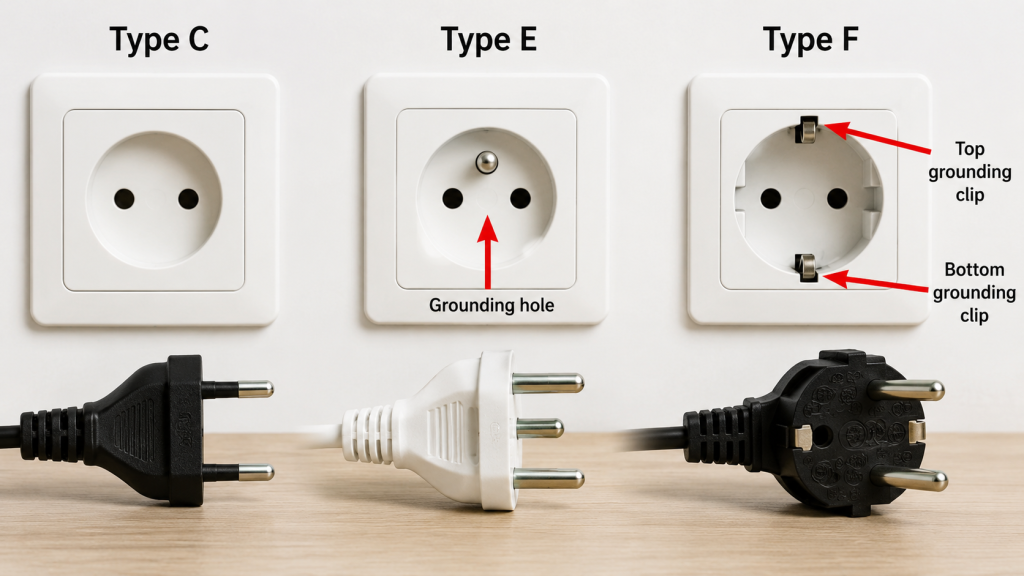
The European power grid relies mainly on these 3 double-headed brothers who can guest each other. Type C (commonly known as European standard plug) has no grounding function and can only be used for low-power equipment below 2.5A such as mobile phone chargers or desk lamps.
Type E (France/Belgium) and Type F (Schuko German Standard-Germany and most of Europe) can handle large items up to 16A. Type F is characterized by a metal grounding shrapnel on the top and bottom of the plug. Type E has a round hole on the plug surface to insert into the protruding grounding pin on the wall socket. Now the European power is very smart, directly with the 1 kind of E/F hybrid plug, plug the two sockets are tightly sewn.
2.Type G (British “heavy armor”)
Structurally, the G-type is definitely the safest 220V household plug designed by humans and is mainly used in the UK, Ireland, Singapore and Hong Kong. It has three very thick rectangular prongs arranged in a triangle.
The most extreme is that each G-plug has a physical fuse (usually 3A, 5A, or 13A) hidden in its belly. In case of a power surge or electrical short circuit, the fuse in the plug will blow before the wires in the wall overheat. And G-type wall sockets all have safety doors, so unless you plug in the longest grounding prong first, nothing else will poke into the live hole.
3.Type I (Oceania and China Standard)
The Type I plug has two flat prongs in an inverted “V” shape, plus a vertical grounding pin. Mainly used in Australia, New Zealand, Argentina and us China.
Interestingly, China’s Type I plug is upside down from Australia’s. The regular version can carry 10A of current, but there is also a 15A or 20A enhanced version that is similar in size (just a little larger) and is specifically used to plug into high-power air conditioners or commercial ovens. The plug of 10 A can be easily inserted into the socket of 15 A, but the plug of 15 A absolutely cannot be inserted into the socket of 10 A, which physically eliminates wire overload.
4.NEMA 6-15 and 6-20 (220V Special Forces in North America)
Although ordinary household sockets in North America are all 110V, when they encounter air compressors, welding machines, electric vehicle chargers “electric tigers”, they will also pull out special lines of 220V-240V. At this time, it is the turn of NEMA 6 series plugs to come on the market.
The NEMA 6-15 is two horizontal flat inserts plus a round grounding pin, rated for 15 amps. The NEMA 6-20 has one of the flat inserts turned vertically (into a “T” shape) to withstand a current of 20 amps. Don’t confuse them with the standard US 110V NEMA 5-15 plugs. If you hard plug them in, the device will die.
A Pitfall-Proof Guide For Seasoned Drivers: The Deadly “German‑Standard Grounding Trap”
Most of the cheap, universal travel‑adapter plugs sold online today have a critical safety flaw: the “Schuko‑style grounding trap.”
When you plug a universal adapter into an F‑type (German‑standard) socket in Germany, the two cylindrical live and neutral pins make contact, and 220V is supplied. However, these universal adapter plugs often lack external metal contacts, making it impossible to engage with the grounding springs located on the upper and lower sides of German‑standard sockets.
At this point, if you plug a metal‑encased imported appliance—such as a high‑end stand mixer or a desktop computer—into this adapter, it will be running directly on 220V without any grounding protection. As long as even a tiny section of the insulation on any wire inside the machine is damaged, the 220V voltage will be directly conducted to the metal casing, and touching it could result in a fatal electric shock. Therefore, if you are equipped with a conversion head for electrical appliances with metal shells, remember to buy a special converter with grounding function in the corresponding area (such as a special American standard to F-type conversion head).
New Trends In 2026: Gallium Nitride (GaN) And USB-C PD 3.1
With the popularity of gallium nitride (GaN) technology and the USB-C PD 3.1 standard, the traditional 220V plug converter is rapidly becoming an antique in the travel circle.
Now those modern GaN chargers with original C- type or G-type plugs can produce 240W of power with a single USB-C line. Whether it’s a high-performance game book, a travel kettle or a professional haircut tool, you’re slowly abandoning your exclusive AC plug. Instead of checking all kinds of 220V plug standards and running around with heavy converters, everyone went directly to the destination to buy a 240W gallium nitride charging head with a local interface, and then used 1 universal DC USB-C line to do everything. This kind of play directly reduces the risk of fire caused by voltage mismatch to zero.
FAQ
Can I plug a 110V appliance into a 220V plug converter?
Absolutely not. The converter only changes the shape of the pin, regardless of the variable pressure. Pouring 220V electricity into 110V electrical appliances will short-circuit, burn the wires inside and even catch fire in an instant. What you need at this time is a step-down transformer.
Are all 220V plugs grounded?
No, that’s not it. Type C (European standard) is a pure two round needle, no grounding. Type A can also pass 220V electricity in some Asian countries, and it is also not grounded. If your device is a metal enclosure or has a heating element, be sure to use a plug with a ground (such as E, F, G, I or NEMA 6 series).
What is the difference between C- type and F-type plugs?
Type C is a flat, ungrounded plug that can only carry 2.5 amperes at most (about 500W at 220V). Type F (German standard) is a strong round plug with grounding shrapnel on the top and bottom, which can handle up to 16 amperes (about 3500W) of current. Never take a C- type adapter with a hair dryer or heater.
Is there a 220V socket in the United States?
There is some. Although the common sockets in American families are 110V(NEMA 5-15), 240V single-phase three-wire circuits are also pulled at home to bring large pieces. For example, electric ovens, dryers and tram chargers use NEMA 6-15, 6-20 or larger 14-30/14-50 sockets specially designed to deal with 220V-240V loads.
Why is there a fuse in the G-plug in the UK?
In the early years, the British power grid used a “ring circuit” with a particularly large total current (up to 32A). In order to prevent the power cord of the electrical appliance from catching fire before the empty opening in the wall jumps when the electrical appliance is short-circuited, the regulations stipulate that each G-type plug must be equipped with a small fuse (usually 3A or 13A) for nearby protection.
How do I know if my equipment can withstand the global 220V voltage?
Look at the label on the power adapter or the words engraved on the machine housing. If the input (Input) column reads “100-240V ~ 50/60Hz”, it means that this equipment has its own wide switching power supply, whether it is 110V or 220V, just plug in a physical adapter.
Can I hard plug the Type I (GB/Australian) plug into the Type G (English) socket?
Don’t even think about it. The shape and spacing of these two prongs are beyond reach. If you “make great efforts to make miracles” and do not plug different types of plugs indiscriminately, you will not only damage the safety door and metal contacts in the socket, but also cause serious arc ignition. Honestly buy a qualified conversion head.