 DTCEE



220v Plug Converter: Adapter Or Voltage Converter?
When the plug in your hand won’t fit into the outlet on site, the most common misjudgment is assuming that “it can be plugged in” means “it can be used safely.” An adapter with different connectors at each end may indeed resolve physical incompatibility, but it does not necessarily address the electrical differences between the device and the power supply.
Products on the market labeled as “220V plug converters” do not, by the term “converter” alone, necessarily indicate whether they include a voltage conversion function internally. To determine what it is, you need to examine its actual structure, nameplate, and technical documentation, rather than relying solely on the product title.
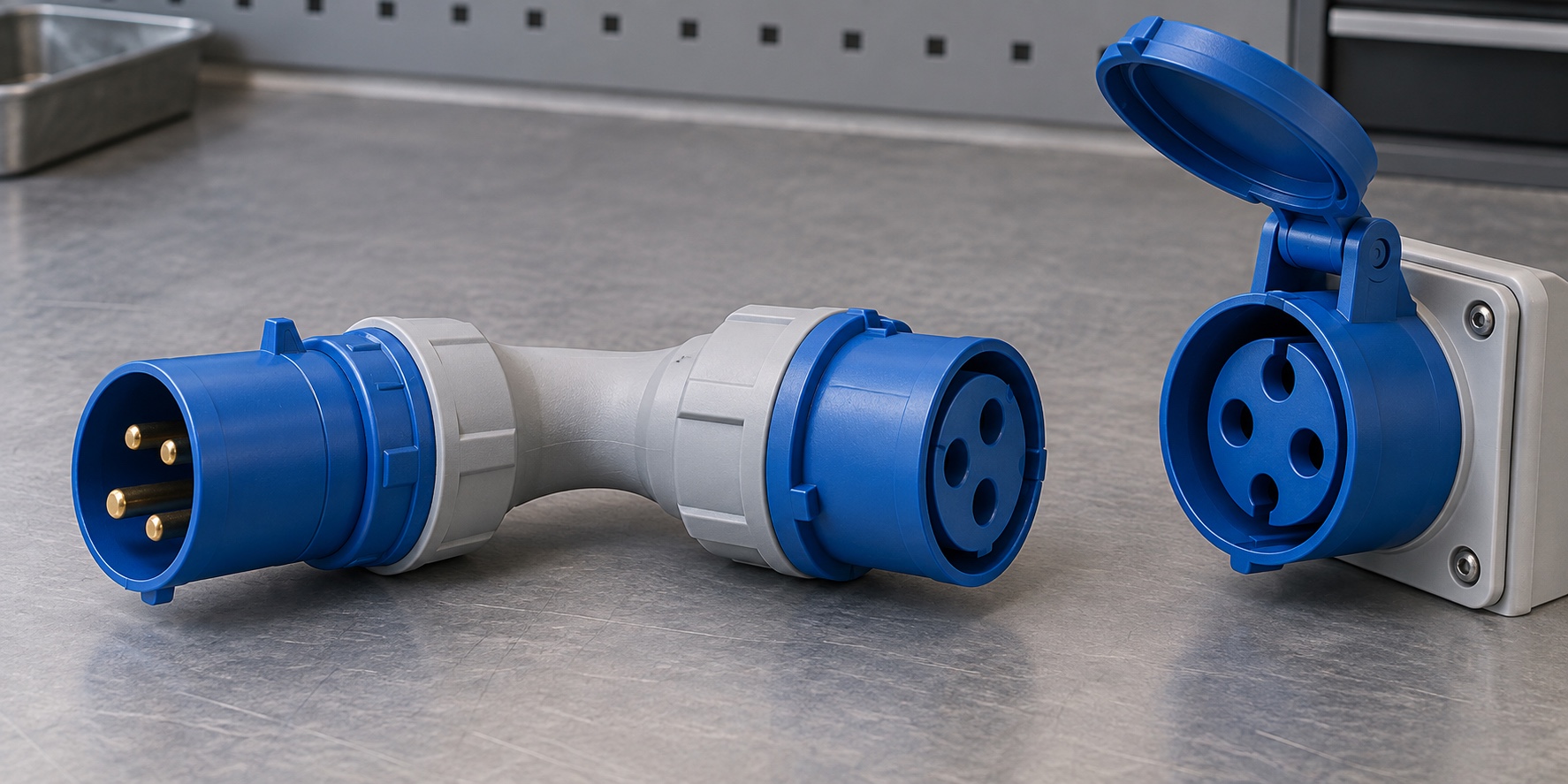
First, Distinguish Between Adapters and Voltage Converters
Standard plug adapters or conversion cables primarily change the connection type. It does not automatically adjust the power supply voltage, frequency, available current, grounding system, or load rating. Even if one end can be inserted into a wall outlet or industrial socket, and the other end can be connected to the equipment, this mechanical fit alone is still not sufficient to prove that the entire connection is functional.
Read the nameplate of the equipment first, confirm the allowable input voltage, frequency and rated current, and then check the on-site power supply. When the allowable input of the equipment is inconsistent with the field system, the problem has exceeded the interface shape; whether a transformer or other adapter device is required shall be judged according to the equipment requirements and complete circuit design. Even after the transformer is added, the frequency, grounding, pole configuration, and protection settings must still be verified individually.
220V Is Not a Complete Specification
220 V, 230 V, and 240V are commonly used as nominal values for power systems. For IEC 60309 industrial interfaces, these products are usually in the identification range of 200V to 250V. Blue is often used to assist in the identification of this range, but the color cannot replace the nameplate.
The conditions that truly determine whether interfaces can be mated also include the standard series, rated current, number of poles, rated voltage range, frequency, the clock position of the protective conductor contacts, keying, and contact arrangement. Two accessories that are both blue and marked with “220V” may still be incompatible due to differences in pole position, clock position, or current rating.
If you encounter a situation where the connector won’t insert, do not shave down the key positions, modify the contacts, or force it in. The anti-misinsertion mechanism is specifically designed to isolate different electrical configurations; bypassing it will only conceal what would otherwise be an obvious mismatch within the circuit.
The Roles at Both Ends Must Also Correspond
The end with the pin and the end with the jack contact are directly paired, but the "male" and "female" are only spoken in appearance and cannot explain whether the product is a plug, a fixed socket, a mobile socket or an appliance input socket.
When checking the adapter, it can be confirmed section by section along the direction from the power supply to the equipment: the pin end on the flexible cable is usually a plug, and the jack end on the flexible cable is usually a mobile socket; the jack product at the fixed wiring end belongs to the fixed socket, and the pin input end fixed on the equipment or structure belongs to the appliance input socket. Both ends must not only match stitch for stitch, but also align in the complete electrical configuration.
The Rated Current Cannot Be Increased by Using an Adapter
An adapter with a higher rated current does not enable the existing outlet, cable, terminal, protective device, or equipment to carry a higher current. The overall connection is limited by each component, and the current rating of the accessory is just one of those limitations.
In particular, when connecting different current ranges, it is essential to re-verify the load design current, equipment operating characteristics, conductor current-carrying capacity, terminal ratings, and upstream protection. Loads such as electric motors, welding machines, and transformers may also involve inrush currents, impact loads, or cyclical operation; therefore, plugs should not be selected solely based on the equipment name or power rating.
Before Placing Your Order, Compile the Information into a Specification Sheet
Don’t just describe it to the supplier as a “220V adapter plug.” Complete the actual requirements: the official product type at both ends, the standard adopted, the rated current, the voltage range, the frequency, the pole position, the clock position, the pin or jack form, the cable condition, the matching model, and the protection conditions required for the connected and unconnected states.
If replacing an existing attachment, record the complete model numbers of both the original product and its mating component, and provide clear images of the nameplate, front interface, and clock position. When reliable identification is not possible based solely on color or side-view photographs, temporarily hold the order and request the supplier to provide the model data sheet and a clear pairing list.
The final judgment is straightforward: first, verify that the equipment’s electrical specifications match those of the power supply; then, confirm that the adapter performs only the connection functions for which it was designed. If any specification is unclear, it should not be verified by trial-and-error insertion.