 DTCEE



220V three-prong plug: What the three prongs really mean
When people see a blue circular plug with three pins on the front, they often immediately refer to it as a “220V three-phase plug.” This judgment is too hasty. The number of pins is merely an aesthetic specification, and 220V is only a nominal voltage designation; neither alone is sufficient to indicate the power‑supply phase configuration, conductor functions, or compatibility with on‑site outlets.
The truly effective approach is to decompose the “three-pin” configuration into the specific functions of each contact, then verify the interface parameters one by one.
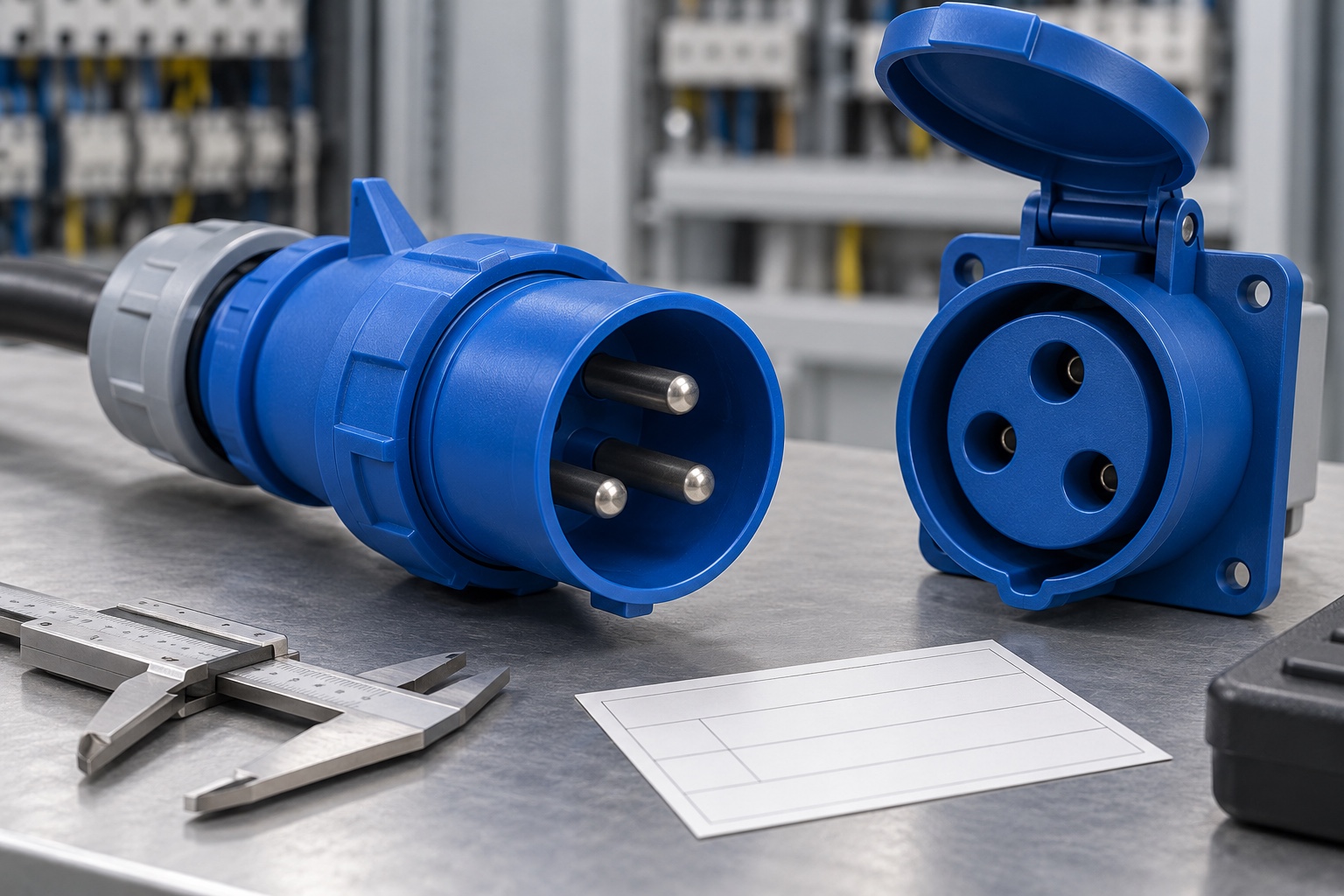
Three-Pin Plugs Do Not Equal Three-Phase Power
In industrial interfaces, the number of phases describes the power supply configuration, while the number of contacts indicates how many conductor functions need to be connected; these are two distinct concepts. 2P E represents two current-carrying poles and one protective conductor contact, with a total of 3 main contacts. 3P E consists of 3 phase conductors plus protective conductors, with four main contacts on the front. Three-phase systems that require a neutral conductor may also use 3P N E, with a total of five main contacts.
Therefore, when you see a 220V three-prong plug, don’t immediately assume it’s “three-phase” just because it has “three prongs.” The equipment nameplate, wiring diagram, and on-site power system should be inspected to verify the function of the two current-carrying conductors and to confirm whether a separate protective conductor is present. Simply relying on “3P” in the product title is not sufficient, as this abbreviation could refer to a three-terminal device or be used ambiguously by sellers to denote three-phase.
220V Has Only Completed Part of the Voltage Verification
220V, 230V and 240V are often used to describe the power system, but the actual product should still be based on the rated operating voltage range and frequency on the nameplate. In the common color coding of IEC 60309, blue is usually used in the range of 200V to 250V. Blue can only help to identify the voltage range initially, but is not enough to prove the number of phases, current level or protection level of the plug.
If the product explicitly adopts IEC 60309 and belongs to the common configuration of 50Hz or 60Hz, 2P E, 200V to 250V accessories usually adopt 6h position. By comparison, the 3P E accessory within the same voltage range uses the 9h position and features four main contacts. Even if the outer colors are the same, two interfaces with different polarity and clock positions cannot be interchanged.
The clock position must be read in accordance with the specified observation direction and evaluated together with the voltage, frequency, and phase angle. Simply comparing blue cases or rotating front-facing photos to make them “look the same” is not a reliable method for matching.
Let’s Look Again at the Rated Current and the Standard Series
After confirming 2P E, the rated current must also be read. Series I in IEC 2010279.88cm inch system commonly uses 16A, 32A, 63A and 125A, while Series II uses ratings such as 20A, 30A, 60A and 100A. Close numerical values do not imply identical dimensions or interface configurations, and accessories with higher rated currents will not increase the permissible load capacity of cables, mating connectors, or upstream circuits.
The 16A and 32A products of the, B and C series all include three-pole models, but "there are three-pole models in the series" cannot replace the confirmation of specific models. At the time of purchase, the supplier should still provide the complete model, rated voltage, frequency, clock position and matching model, and all parameters of the current model should not be inferred from other products in the same series.
The Pin and the Socket Must Be Confirmed as a Matching Pair
Industrial plugs typically feature pin-type connectors for flexible cables and can be mated with fixed or portable receptacles equipped with socket contacts. Although appliance inlet sockets also have pins, they are fixed to the equipment or structure; the two pin terminals cannot be connected directly. Similarly, both fixed sockets and portable sockets have receptacle ends and do not constitute a pair of directly mating components.
When replacing existing accessories, it is best to record the complete type of plug and socket at the same time, and photograph the nameplate, front contact and clock position. Just because the mechanical components can be brought close together or even squeezed in does not mean the electrical configuration is correct. If the components cannot be mated naturally, stop immediately; do not cut keyways, dismantle the locating structure, or force the connection.
Verify the Environmental and Wiring Conditions Last
After interface matching, confirm the IP rating, cable outer diameter, number of cores, conductor cross-sectional area, terminal range, clamping mechanism, and operating environment. The nominal IP rating is related to the cover plate, lock ring, seal and insertion state; when the protection conditions at both ends are inconsistent, the complete connection should be evaluated on the side with lower or more restrictions.
Before wiring, you should also obtain the installation instructions and wiring diagram for the corresponding model. The protective conductor must be connected to the designated grounding terminal; the neutral conductor and the protective conductor shall not be used interchangeably. Fixed wiring, exposed terminals, and pre-energization verification shall be performed by qualified electrical personnel in accordance with local regulations and the manufacturer’s instructions.
Before placing an order, rewrite "220V, three needles" into a complete specification: what standard is adopted, what is the official product type, whether it is 2P E, what is the rated current and frequency, where is the clock position, what kind of jack terminal is needed, what is the protection status and cable conditions. As long as any one item remains unconfirmed, first supplement the nameplate or model information; do not substitute trial insertion for verification.