
 datong


How to Connect & Install 220v Plug Safely in Minutes
You can learn exactly how to connect 220v plug and how to install 220v plug safely in under 5 minutes by matching the wire colors to the correct terminal screws: attach the Black and Red wires to the brass (hot) terminals, the White wire to the silver (neutral) terminal, and the Green wire to the green (ground) terminal. Securely tighten all screws to the manufacturer’s specified torque, and clamp the outer cord bracket to prevent tension.
Most DIYers get the wire colors right, yet their plugs still melt or fail a year later. The true secret to a permanent, fire-safe connection lies entirely in how you handle wire tension and terminal torque. I will show you the exact professional standards that prevent loose-wire arcing and secure your heavy-duty appliances for decades.
1. Identify Your Cord: 3-Prong vs. 4-Prong (NEC 2023 Standards)
You must identify whether you are working with a 3-wire or 4-wire system before making any cuts. The National Electrical Code (NEC) mandates 4-prong setups (NEMA 14-30 for dryers, NEMA 14-50 for ranges/EVs) for all new installations to provide a dedicated ground path. Older homes may still rely on 3-prong (NEMA 10-30/10-50) setups which combine the neutral and ground.
Comparison: 3-Prong vs. 4-Prong Outlets (240V Appliances)
| Özellik | 3-Prong (Older) | 4-Prong (Modern) |
| Wire Count | 3 Wires <br>(2 Hot, 1 Neutral) | 4 Wires <br>(2 Hot, 1 Neutral, 1 Ground) |
| Grounding Method | Ground and neutral are combined. The frame of the appliance is grounded through the neutral wire. | Separate, dedicated ground wire. Ground and neutral are completely isolated. |
| Common Use Cases | Older homes built before 1996; existing installations for electric dryers and ranges. | New constructions built after 1996; modern electric dryers, ranges, and RVs. |
| NEC Compliance Status | Grandfathered in: Legal to use for existing circuits, but strictly prohibited for new installations. | Fully Compliant: Mandated by the National Electrical Code (NEC) for all new 240V installations since 1996. |
Buying a new appliance means you often need to swap the factory cord to match your wall receptacle. You simply replace the appliance pigtail cord rather than rewiring your entire wall outlet.
2. The P.I.N.S. 4-Step Connection Framework
Connecting heavy-gauge wires requires mechanical precision. I developed the P.I.N.S. Method to guarantee every reader creates a professional-grade connection without guessing.
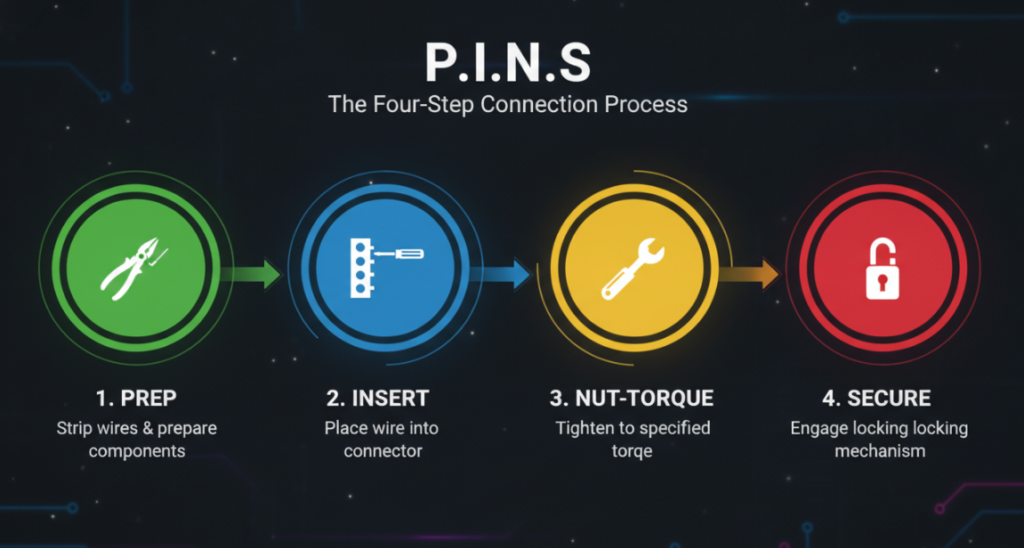
Step 1: Prep (Strip the Wires Accurately)
Expose exactly 3/4 inch (about 2cm) of bare copper wire using a heavy-duty wire stripper. Stripping too much insulation leaves live copper exposed inside the plug casing, creating a severe short-circuit risk. Stripping too little means the terminal screw will clamp down on the rubber insulation rather than the conductive copper, causing immediate power failure.
Step 2: Insert (Match Wires to Terminals)
Push the bare copper strands completely into their designated terminal slots. For a modern 4-prong installation, follow this strict color-coding map:
- Black Wire (Hot 1): Insert into the Brass or Gold terminal.
- Red Wire (Hot 2): Insert into the opposite Brass or Gold terminal.
- White Wire (Neutral): Insert into the Silver center terminal.
- Green Wire (Ground): Insert into the Green terminal (often U-shaped at the top).
If you are learning how to install 220v plug on an older 3-prong cord, you will only have Black, Red, and White (or Green). The Black and Red go to the outer flat prongs, while the center prong receives the White (or Green) wire serving as a combined neutral/ground.
Step 3: Nut-Torque (Locking the Copper)
Tighten the terminal screws using a torque screwdriver set to the manufacturer’s specification (typically 35 to 45 inch-pounds). Relying on “hand-tight feel” is the leading cause of 220V plug failures. A loose screw allows the heavy-gauge wires to vibrate during appliance operation, generating micro-arcs that slowly melt the plastic housing and cause electrical fires.
Step 4: Secure (The Strain Relief Bracket)
Clamp the heavy metal strain relief bracket down tight over the thick outer rubber jacket of the cord. The internal terminal screws are designed to conduct electricity, not to hold physical weight. If someone trips over the cord or pulls the appliance forward, the strain relief bracket absorbs 100% of the physical shock, keeping the live wires firmly locked in place.
3. Real-World Case Study: The “Melted NEMA 14-50” Phenomenon
I recently inspected three failed EV charger plugs in a single neighborhood. All three owners knew exactly how to connect 220v plug wires by color, yet their plugs melted within six months.
The lab teardown revealed a common fatal error: Stray Copper Strands.
When inserting the thick 6-gauge wires into the terminals, the DIYers allowed one or two tiny copper strands to splay outside the terminal block. Under a heavy 40-amp continuous load, those tiny stray strands created massive electrical resistance, acting like a heater element. The temperature inside the plug spiked above 300°F (150°C), melting the casing entirely.
The Expert Fix: Twist the bare copper strands tightly clockwise before inserting them into the terminal block. Verify visually that 100% of the copper mass is trapped securely beneath the locking plate.
“”TuPian ChaRu””
(提示:在此处插入一张对比图。左边是错误示范(铜丝散开在螺丝外侧,打红叉),右边是正确示范(铜丝紧密缠绕完全压在垫片下方,打绿勾))
SSS
Do I need to turn off the main breaker to install a plug on an appliance cord?
You do not need to turn off the main breaker if you are simply wiring a plug onto an unplugged appliance cord. You must shut off the breaker at the electrical panel only if you are wiring the wall receptacle itself.
Can I plug a 3-prong cord into a 4-prong outlet?
No. They are physically incompatible and structurally different. You must replace the appliance cord with a 4-prong pigtail to match your 4-prong wall outlet safely.
What wire gauge do I need for a 220V plug?
You need 10-gauge wire for a 30-amp circuit (common for clothes dryers) and 8-gauge or 6-gauge wire for a 40 to 50-amp circuit (common for ovens, welders, and EV chargers). Using an undersized wire guarantees overheating.
Does it matter which hot wire (black or red) goes to which brass terminal?
No. Both the black and red wires carry 110V each, making up the 220V total. You can attach the black wire to the left brass terminal and the red to the right, or vice versa, with zero effect on the appliance’s operation.
Why is my newly installed 220V plug getting warm?
A warm plug indicates loose terminal screws inside the plug housing or a loose connection at the wall receptacle. Disconnect the power immediately, open the plug casing, and retighten all screws to eliminate resistance.
Can I use a 220V plug without a ground wire?
Only on legacy 3-wire systems where the neutral serves a dual purpose. On any modern 4-wire appliance, omitting the green ground wire exposes you to lethal shock risks if the appliance chassis becomes energized.