 datong


How To Replace A Socket Cover
31Learn How To Safely Replace A Socket Panel With This Expert Guide. From Preparation To Final Installation, Ensure Your Home Stays Safe.
View details
Search the whole station
The core reason why industrial sockets burn out is nothing more than extreme heat caused by high contact resistance, electrical overload or loose terminals. The most common bane is actually a “thermal runaway” cycle: poor physical contact between the plug pin and the socket socket leads to local arcing and oxidation. This oxide layer pushes up the resistance and temperature further until the thermoplastic shell reaches the melting point or is directly carbonized. Especially in the heavy-duty environment, if the protection level (IP) is selected to be low, causing water and dust to enter, or the cable thickness does not match the current, the aging speed of the insulation layer will be very fast, and finally the terminal will be completely scrapped or even end up on fire.
In the field of industrial power distribution, the integrity of the connection is the life gate. High contact resistance is often the “invisible killer” before the socket burns out. When the terminals become loose-whether it’s because of the vibration of the plant equipment or the screwing of the installer-the effective surface area through which the current flows is greatly reduced.
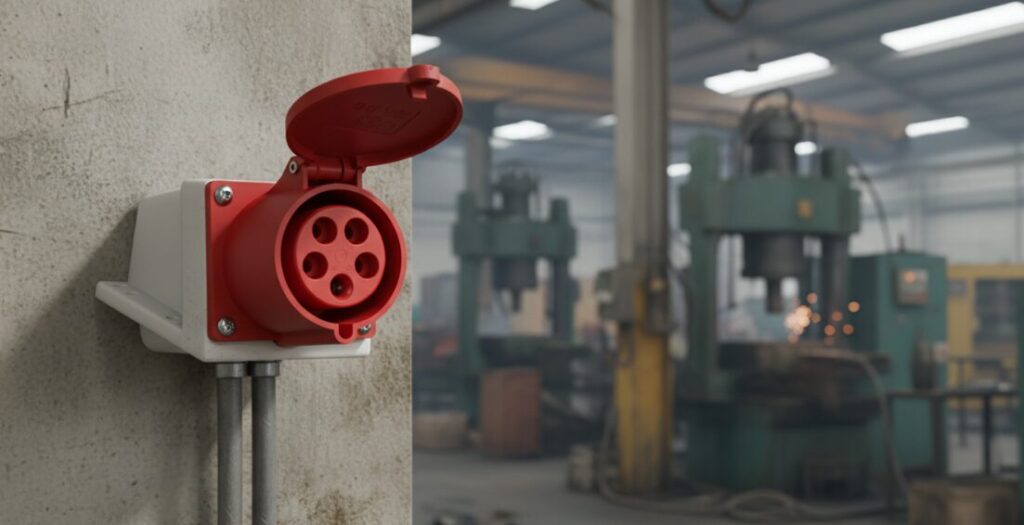
This “necking effect” forces the current through a very small path, creating intense local high temperatures. As the temperature rises, the metal components will continue to expand and shrink, which in turn makes the connection more loose, thus falling into the so-called “thermal runaway” cycle. If you leave it alone, this process will eventually lead to carbonization of the internal structure of the socket, making the entire device useless and extremely dangerous.
Electrical overload is still one of the main causes of industrial field socket failure. When the current drawn by the machine exceeds the rated carrying capacity of the socket, the thermal stress on the internal components will directly explode.
This situation is often accompanied by the problem of improper cable selection. For example, if the current carrying capacity of the cable does not match the requirements of the socket, the cable itself will become a heat source. Excess heat can be conducted from the wires directly into the socket terminals, accelerating the degradation of the insulating material and eventually causing the thermoplastic housing to melt. Many times people only stare at the socket, but forget that the cable is actually part of the entire thermal balance system.
The working environment and electrical load of the socket are equally important. In heavy-duty environments, water vapor, dust and chemical fumes are ubiquitous threats.
If the IP rating of the socket is selected low, contaminants will penetrate into the interior of the enclosure. Moisture can cause rapid oxidation of copper or brass pins. As we all know, metal oxides are poor conductors of electricity, which will push up the resistance, thus adding fuel to the “thermal runaway” cycle. In high humidity environments, high quality sockets of IP44 or even IP67 must be selected, which is the bottom line to prevent humidity-induced flashover and catastrophic terminal failure.
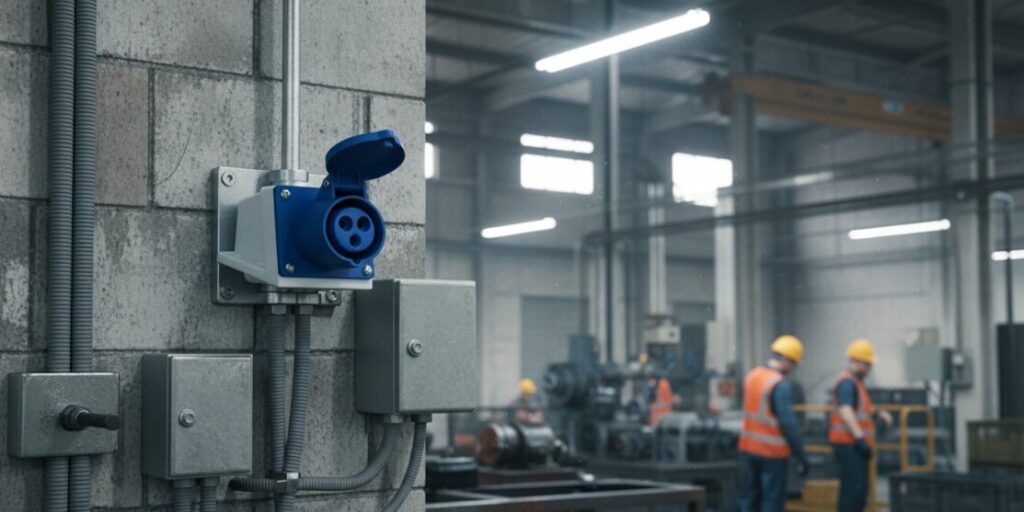
The consequences of a burned socket are not as simple as changing parts, it hides the risk of electrical fires and the huge cost of unplanned downtime. Once the shell reaches the melting point or begins to carbonize, the risk of short-circuiting increases exponentially.
In order to maintain the safety and efficiency of the production line, engineers must implement the following points:
Understanding why industrial sockets burn, the maintenance team can shift from “fire-fighting maintenance” to “active prevention” to preserve the life of the power connection system from the source.
Author: Alex Sterling
“I am an R&D Engineer specializing in industrial power distribution and electrical safety. With years of hands-on experience analyzing field failure cases, I have seen firsthand how minor issues like contact resistance can escalate into catastrophic thermal runaway. My mission is to help facility managers and maintenance teams move beyond ‘fire-fighting’ by understanding the technical nuances of equipment failure. “

Learn How To Safely Replace A Socket Panel With This Expert Guide. From Preparation To Final Installation, Ensure Your Home Stays Safe.
View details
Standard Plugs Aren’T Waterproof. Learn Why IP-Rated Plugs Are Critical For Safety And Preventing Electrical Hazards Today.
View details
Explore Global Socket Types, Voltages, And Safety Standards Like UL/CE To Ensure Secure Electrical Infrastructure.
View details
Is Sleeping Next To A Wall Socket Safe? EMF Is Harmless, But Electrical Fires Aren’t. Read Our Bedside Safety Guide.
View details Optimized by Seraphinite Accelerator
HelloPlease log in