 datong


How Far Should Socket Be From Sink
Electrical outlet must be at least 2 feet from the edge of the sink to prevent direct liquid contact. There’s also the crucial point that as long as the outlet is within 6 feet of the inside upper edge of the sink basin, a ground fault circuit breaker or leakage protector must be installed.
However, in actual mobile vehicle maintenance environments ——splashing water, high-pressure flushing, space buckling, and severe vibration are commonplace——, when I do infrastructure safety reviews, I usually mandate that regular outlets be at least 3 feet away from the direct splash zone. If the space is so tight that you can only install the power supply next to the water source, completely abandon those ordinary household sockets and directly replace them with heavy-duty waterproof industrial sockets with high protection level. Otherwise, if a fatal short circuit occurs, the consequences will be disastrous and compliance will be impossible to discuss.

Understanding The Standard Of National Electrical Code
In terms of defining the distance between sockets and sinks, NEC actually gives the most basic safety passing line. The requirement for ordinary sockets to be kept 2 feet apart is to cope with the random splashing of liquid during normal daily use.
In addition, GFCI or RCD leakage protection must be installed within 6 feet, which is not negotiable. Everyone knows how powerful water is at conducting electricity. If you are using a power tool in this 6-foot radius and your hand slips into the water basin, or you are suddenly sprayed with water mist, GFCI/RCD can instantly detect the fault and cut off the power supply. In standard configuration, this extremely rapid response is the core line of defense against electric shock.
Real-World Challenges In The Maintenance Environment
Normally, the NEC standard for kitchen use at home is sufficient, but if you change the scene to a mobile workshop, RV or garage, the environmental variables increase exponentially. In places where such rough work as vehicle maintenance is done, the risk index jumps up in geometric order.
This is not the stable vegetable washing pool you have at home. These sinks in working conditions have to withstand a lot of trouble:
- Water sloshing: As soon as a mobile workshop or RV is opened, water in the sink can easily overflow violently over the edge.
- High-pressure flushing: Washing car parts basically requires a high-pressure water gun, which not only creates an unpredictable splash zone, but also fills the air with a dense layer of conductive water mist. Seriously, this water mist is often more dangerous than just throwing water.
- Severe vibration: The continuous vibration of the machine, generator or vehicle itself will loosen the wires that were originally connected well over time, and the chance of arc fire will be directly increased.
Based on these extreme factors, those of us who are involved in compliance and security often adopt a more conservative strategy: directly widening the security distance to 3 feet. In such harsh working conditions, using household standards as a proxy is not enough to show safety redundancy.
Dealing With Tight Spaces And Site Constraints
However, the reality is often impersonal. Whether you’re building a mobile unit or a compact garage, space is always a scarce resource. In many tight areas, you want to strictly cut a distance of 3 feet or even 2 feet between the power supply and the edge of the sink, which is physically impossible to do. In order for machines and tools to plug in smoothly, you may be forced to install the power supply next to the water source.
When space forces you to this point, and then the iron goes to use a regular household socket, that’s killing you. Ordinary sockets were not designed with any thought to withstand high-pressure water flow, let alone adapt to the harsh environment of the operating area. At times like these, abandoning household outlets altogether is long gone “recommended”, but rather the deadly safety red line that must be enforced.
The Need To Upgrade Heavy-Duty Waterproof Industrial Sockets
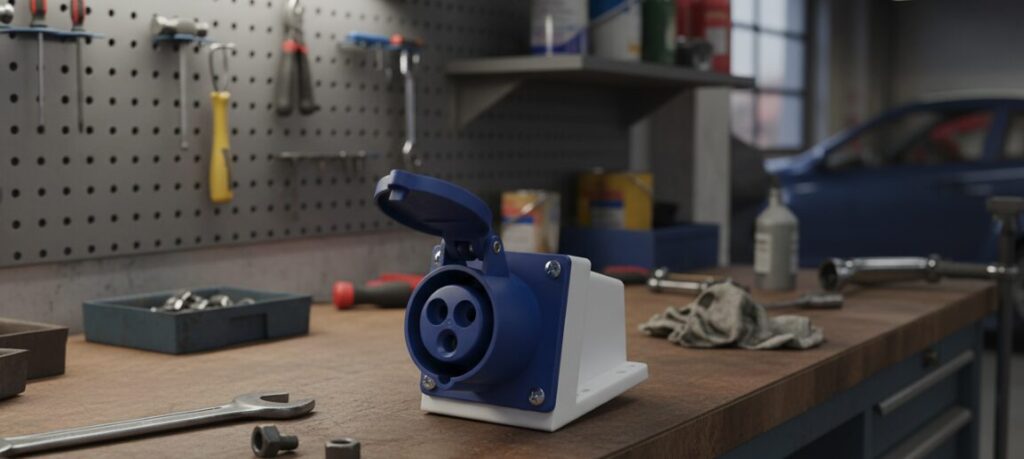
If you have to install power next to your sink in this demanding environment, there’s only one solution: go directly to a heavy-duty, waterproof industrial outlet with a high IP rating. The high protection rating can ensure that the socket is tightly sealed inside, dust-proof and debris-proof. The most critical thing is that it can withstand direct water jet and severe liquid splashing.
Replacing it with these leather industrial-grade plugs and sockets means you have established an electrical connection that cannot be splashed with water. It is not a problem to flush it under high pressure, shake the water flow or vibrate it violently. The shell material of these industrial-grade accessories is extremely strong, and the locking mechanical structure inside is also very tight. It can not only prevent fatal short circuits and protect your expensive equipment, but also keep the safety of operators. Most importantly, with these high-performance industrial solutions, your mobile workshop or garage can be truly watertight on the electrical system, fully complying with stringent global safety standards. In this way, no matter how close the power source is to the water, you will have enough confidence.
Author: David Mitchell
“Hi, I’m an electrical safety inspector and compliance consultant specializing in mobile workshops, RVs, and custom garages. Over the years, conducting countless infrastructure safety reviews has shown me firsthand the catastrophic risks of mixing high-pressure water with inadequate wiring.”