 DTCEE



How To Wire 220v Plug With 3 Wires: Safe & Easy Steps
If your home still has three‑hole dryer or stove outlets, you don’t necessarily need to replace them with four‑hole outlets right away when upgrading your appliances. However, three-wire connections are not legal or safe in all circumstances.
3-Wire vs. 4-Wire 220V Plugs
| Caraterística | 3-Wire 220V Plug | 4-Wire 220V Plug |
| NEMA Types | NEMA 10-30 (Dryer) NEMA 10-50 (Range) | NEMA 14-30 (Dryer) NEMA 14-50 (Range) |
| Wire Colors | Preto (Hot 1) Red (Hot 2)Branco (Combined Neutral/Ground) | Preto (Hot 1) Red (Hot 2)Branco (Neutral)Green / Bare Copper (Ground) |
| NEC Compliance Dates | Banned for new installations in 1996 (Legal for existing setups under the grandfather clause) | Required for all new installations since 1996 |
| Usage / Installation Rules | Appliance Cords: Legal to install on a new appliance only to match an existing older wall outlet.Wall Outlets: Never install a new 3-prong wall outlet. | Appliance Cords: Standard on modern appliances.Wall Outlets: Required configuration for all modern homes and new wall outlet installations. |
In accordance with the relevant exceptions of the NEC, only existing branch circuits that meet specific conditions may continue to use a three-wire connection. This method cannot be used for newly constructed or upgraded lines, nor in locations where local regulations require a four-wire connection. Before starting the installation, refer to the appliance’s original manufacturer’s instructions and have a licensed electrician verify that the existing wiring complies with local codes.
H-N-T Principle For Three-Wire 240v Power Connections
Understanding H-N-T—namely, the hot wire, the neutral wire, and the torque—can help people grasp the fundamental logic of a three-wire connection. However, it cannot replace the original wiring diagram provided by the appliance manufacturer or local electrical codes.
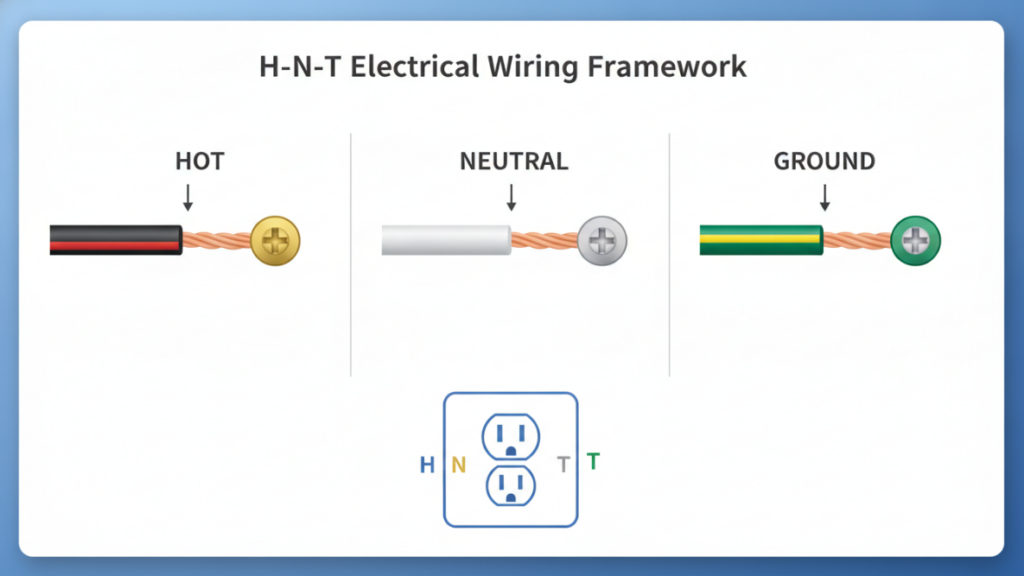
Connect The Hot Wire To The Outer Terminal.
On most dryer and electric stove terminal blocks, the terminals on either side are used to connect the two live wires, typically labeled L1 and L2, and some of these terminals are brass-colored.
In a typical split-phase residential power system in the United States, the nominal voltage from each hot wire to neutral is approximately 120 V, while the voltage between the two hot wires is about 240 V. For typical resistive heating loads, the two live wires can usually be interchanged; however, the wiring diagram specific to the model should always be consulted.
Connect The Neutral Wire To The Central Terminal (Neutral).
The central terminal is typically used to connect the white neutral wire, which may also be marked as N.
In compliant existing three-wire installations, the neutral conductor not only supplies 120V circuits to timers, lighting, and control circuits, but may also be connected to the metal enclosure via a neutral bonding jumper inside the appliance. Precisely because the neutral conductor and the protective earth are not separated, modern new installations and retrofits typically require a four-wire connection.
Whether a three-wire system is permitted depends on the existing branch circuit configuration, conductor sizes, local regulations, and the requirements of the electrical equipment manufacturer; it cannot be determined solely by the appearance of the wall outlet.
Apply Torque As Specified By The Manufacturer.
If the terminal is not tightened properly, it may overheat due to increased contact resistance; if it is tightened too much, it can damage the threads, crush the terminal, or cut the conductor.
Therefore, you should not simply “tighten as hard as possible,” nor should you apply a fixed torque value to all electrical appliances. The correct procedure is to consult the installation manual or terminal labels for the specific model and use a torque tool set to the manufacturer’s specified value.
What Needs To Be Prepared Before Installation?
240V appliances typically operate at higher currents, such as 30A, 40A, or 50A, so the power cord, plug, terminals, and strain-relief clamps must be matched to the appliance’s rated current.
Common Tools Include:
-A screwdriver or socket that matches the screw specifications;
-A torque screwdriver or torque wrench that can be adjusted to the manufacturer’s specified value;
-A complete power cord assembly that is approved and compatible with the electrical appliance and outlet;
-Strain relief clip included with the power cord;
-Voltage testing equipment used by qualified personnel to verify the de-energized status.
For clothes dryers, select a UL-listed power cord assembly that matches the specifications of both the outlet and the appliance. For example, a common three-wire power cord for a 30A clothes dryer should be paired with a NEMA 10-30R receptacle, while a four-wire power cord is typically used with a NEMA 14-30R receptacle.
Do not use loose cables to temporarily create power cords, nor should you assemble components with different
Current Ratings Or Different Terminal Types.
Correct wiring approach for a three-wire power cord
The following content is provided solely to aid in understanding common connection configurations and should not be used as a substitute for the installation manual specific to each model. If the color of the terminal block, jumper, or wire does not match the instructions, stop operating immediately.
Confirm Whether The Three-Wire Connection Is Applicable.
Before disassembling any components, the following items should be confirmed:
-This is an existing three-lane branch road that complies with local regulations;
-The appliance manufacturer explicitly permits the use of a three-wire connection for this model.
-The power cord’s rated current, rated voltage, and plug type must match the appliance and the outlet.
-The bonding method between the neutral conductor and the enclosure complies with the equipment’s instruction manual.
-The wiring and outlets show no signs of scorching, looseness, discoloration, or overheating.
For new or upgraded lines, or when local regulations prohibit connecting the enclosure to the neutral conductor, a four-wire connection should be used.
Completely Disconnect The Power Supply.
Before performing any operations, disconnect the power plug. If the equipment is hard-wired, also switch off the corresponding circuit at the distribution panel and implement measures to prevent accidental re-energization by others.
You cannot assume that the power has been cut off solely because the equipment has not started. Measuring and verifying 240V circuits requires specialized knowledge; if you are not familiar with the multimeter’s range settings, measurement positions, or voltage-testing procedures, have a licensed electrician perform the work.
Installation Stress-Relief Clamp
At the point where the power cord enters the metal enclosure of the equipment, a strain relief device that matches the cable must be installed. The clamp shall secure the outer sheath of the power cable and must not exert direct pressure on the individual internal conductors.
This prevents external forces from being directly transmitted to the terminal block when moving electrical appliances or pulling on the power cord.
Connect The Central Terminal
The neutral conductor of a three-wire power cable is typically connected to the center terminal on the terminal block. In some finished power cords, the neutral conductor is white; in others, it is distinguished by visual markings.The neutral bonding strip inside the electrical appliance shall be installed in accordance with the three-wire wiring diagram for that model, ensuring that the central terminal maintains the connection specified by the manufacturer relative to the enclosure. The structure may vary among different brands and model years, so do not move the overlap plates based on experience alone.
Connect The Terminals On Both Sides
The other two conductors are connected to the L1 and L2 terminals on either side of the terminal block.During assembly, ensure that the terminals are seated flush and that no insulation is trapped between the metal contact surfaces, and that no copper wires, wire lugs, or washers protrude into areas where they could come into contact with the enclosure. Original‑equipment power cords typically come with ring terminals or fork terminals featuring a flange; do not cut them off and convert them to bare wire connections without authorization.
Tighten To The Specified Torque.
All terminals shall be tightened to the torque specified by the manufacturer. After completion, verify that the conductors are securely fastened, the terminals are flush, and the strain relief clamps are properly gripping the outer jacket.
Then reattach the terminal cover plate. Do not energize the equipment when the cover plate is not installed.
Common Hazard: Damage To Conductors Or Terminals
High-current electrical appliances are highly sensitive to connection quality. Insufficient conductor cross-sectional area, severed copper strands, poor crimping of lugs, or loose terminals can all lead to increased local resistance.
When current passes through a high-resistance connection point, heat is generated, which over time can cause discoloration of the insulation, melting of the connector, and even lead to a fire. Therefore, whenever any of the following issues are detected, the entire power cord assembly should be replaced rather than continuing to use it as is:
-The copper wire is cut or broken;
-The terminal is discolored, ablated, or loose;
-Outer jacket cracking;
-The plug has overheated or become deformed;
-The power cord specifications do not match the equipment’s rated current.
-The stress-relief clamp is missing or unable to securely fasten the cable.
Frequently Asked Questions
Does It Matter Which Of The Two Live Terminals The Two Live Wires Are Connected To?
For most dryers or electric stoves that use a standard two-phase power supply, the two live wires are connected to L1 and L2, and they are typically interchangeable. However, the equipment wiring diagram shall still prevail. If the equipment manual clearly specifies the wire routing, installation must strictly follow the instructions.
Where Is The Ground Wire On A Three-Prong Plug?
Traditional three-wire dryer or electric stove power cords do not have a dedicated equipment grounding conductor. Eligible existing installations connect the metal enclosure via the neutral conductor and the internal bonding strap.
This does not mean that the neutral conductor can be used as a grounding conductor under all circumstances. This method is applicable only to specific existing installations permitted by regulations. In a four-wire system, the neutral conductor and the equipment grounding conductor are separated, and the equipment enclosure is connected to a separate protective earth conductor.
Can A Three-Prong Plug Be Inserted Into A Four-Hole Outlet?
Cannot. Three‑prong and four‑prong plugs have different mechanical designs; for example, the common NEMA 10‑30 and NEMA 14‑30 cannot be interchanged.
Do not use an adapter to bypass the grounding requirement. The appropriate, qualified power cord for the equipment should be installed in accordance with the wall outlets, existing wiring, local regulations, and the appliance’s instruction manual. GE also explicitly states that existing buildings may continue to use three-wire power cords where conditions permit, while new installations or renovations are required to use four-wire connections.
Any situation that cannot be confirmed should be inspected by a licensed electrician before power is restored.