 datong


What To Do When Socket Blown
If your plant or heavy machinery happens to experience a burning outlet, here’s a straightforward, step-by-step emergency plan you need to implement right now:
First, never touch that outlet, plug, or heavy equipment attached to it. Especially if you smell a pungent burnt smell, hear “snap” electrical discharges, or already clearly see charred marks and melted plastic. The only priority you have to consider at this time is to stop a catastrophic electrical fire. Immediately evacuate the surrounding people, then find the distribution box as quickly as possible, pull down the main gate or cut off the specific circuit breaker that supplies power to the area. Once the power is completely cut off and the ignition stops, contact a qualified electrician immediately and don’t even think about doing the repair yourself. In a commercial or industrial environment, a burning socket is rarely a simple accident; it’s almost always a warning of a circuit overload or a severe current mismatch, indicating that your current electrical infrastructure simply can’t handle the constant heavy load of a machine.
Why Never Touch The Fault Socket
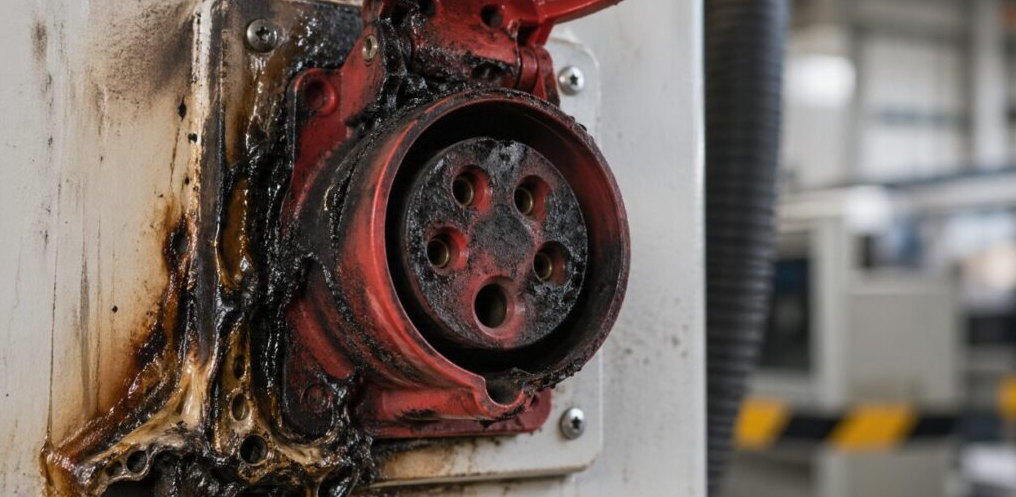
If there is a problem with high-voltage industrial connections, the movement is usually not small. You may smell a very sharp, pungent burning smell, hear a sudden popping or crackling sound, and then see black burn marks or even melted plastic around the socket. When many people encounter a burned-out socket, their instinctive reaction is often to quickly unplug the socket and save the machine —— stop it. Don’t do that.
Melting plastic means that the internal components have reached extremely high temperatures and the insulation has been completely scrapped. At this point, if you touch the socket, plug, or even just the metal casing of the heavy equipment, it could be a fatal electric shock or directly trigger the terrible arc flash. Your absolute highest priority right now is preventing vicious electrical fires and protecting human lives. Back off immediately and maintain a safe distance.
Evacuation And Complete Power Outage
In a business environment, an electrical failure can develop into a fire that lasts only seconds. The site was cleared in case of a sudden fire or explosion, at least no one was in danger.
After controlling the site, quickly locate the main distribution box of the factory. Don’t always think about isolating the problem on the device side, that’s futile. Find the circuit breaker that controls that fault area directly and pull it to the “OFF” position. When checking, I often encounter situations where the distribution box labels are messed up. If you can’t figure out which switch is responsible for which electricity, don’t hesitate and just pull the main gate. Cutting off the power at the source is the only reliable way to block the continuous fire and prevent the spread of electrical fires.
Wait For Professional Intervention
Once the power is completely cut off and the immediate danger is relieved, your next step is to call a certified commercial electrician. Whatever the case, and regardless of how tight the production schedule is, don’t let your people or yourself try to fix a burned-out, heavy-duty outlet.
Industrial power systems that drive high-current machinery (such as large-scale manufacturing equipment or new energy devices) are extremely complex. Professional electricians have specialized diagnostic instruments in their hands that can test the wiring, assess the true extent of thermal damage within the wall, and ensure the entire circuit is absolutely safe before re-energizing. Replacing the outlet yourself not only violates commercial safety regulations, but what is even more terrifying is that the hidden electrical hazards are not dealt with at all.
Uncover The Root Cause
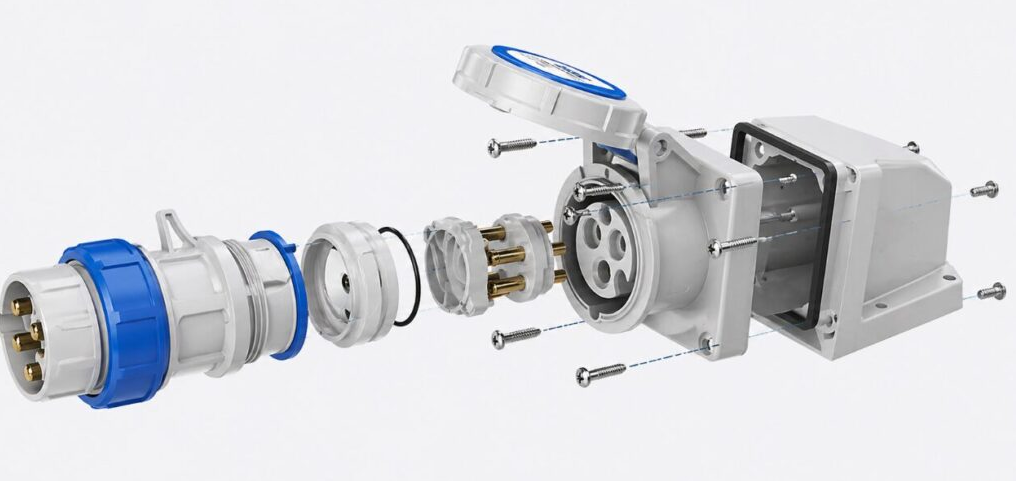
If in an ordinary home, a burnt socket may just be an aging component. But on industrial sites, a burning socket is by no means just a minor accident. It’s actually a serious warning from your system that your electrical architecture has a hard injury ——most commonly circuit overload or severe current mismatch.
Heavy machinery requires a continuous, stable high power input. If your device draws more current than the rated capacity of the plug and socket, the contact resistance will generate a lot of heat. It was this constant heavy load that eventually baked up the plastic, causing the socket to burn out completely.
This failure makes it very clear that your existing electrical infrastructure simply cannot handle the actual operational needs of these machines. To prevent this dangerous scenario from recurring, plant managers must invest in high-quality, industrial-grade plugs and sockets specifically designed for heavy loads that support universal voltage and consistently high current output. Upgrading directly to rugged, globally compliant industrial electrical connectors is the only way to ensure your machines can operate safely, continuously, and efficiently without putting your entire plant in fire danger.
Author: Mark Stevens
My career has been defined by a focus on high-performance distribution systems and uncompromising safety standards. I write to help homeowners and industrial professionals understand the technical limits of their electrical gear, ensuring that every installation remains safe, reliable, and efficient—no matter how harsh the environment.