 datong


Why Do Sockets Spark
This is usually caused by inrush current—inrush current within a few thousandths of a second of the insert touching the live contacts, the circuit closes, producing a small blue spark. It is crucial for commercial space supervisors or new electricians to distinguish this “normal phenomenon” from a serious fire hazard. That tiny, fleeting, blue spark is safe. On the contrary, if you see a bright yellow or white fire, hear a distinct “snap” sound, smell a burnt smell, or notice that the socket panel has burned and changed color, the nature has completely changed. You’re dealing with “arcing”, which is usually caused by loose wiring, excessive contact resistance due to oxidation of the terminal blocks, or a short circuit. In that high-load electrical environment, these sparks are actually an alarm: the metal shrapnel inside the socket has tired and lost its elasticity, or the socket cannot withstand such a large current at all, and the hardware can no longer withstand it. In this case, it must not be delayed and must be replaced immediately with high-standard industrial-grade components, otherwise the next step may be equipment damage or even fire.
Visual Basis For Judgment
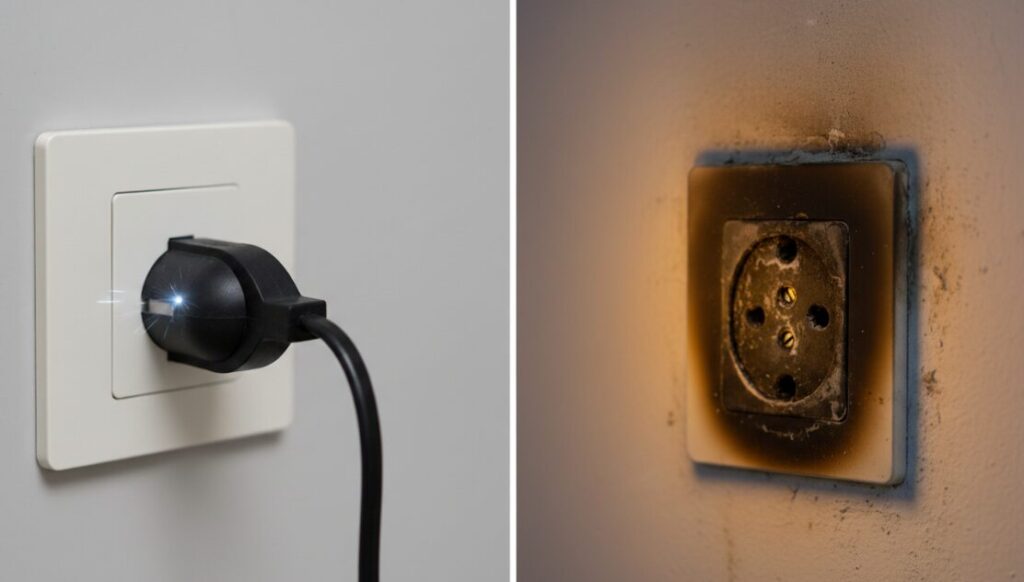
In any electrical installation work, figuring out the physics behind the spark is the first step to safety. Sparks are also divided “three, six, nine, etc.”, and color and duration are the most intuitive diagnostic tools.
“Blue flash ”: This is a standard physical phenomenon. When a high-power device is turned on, it draws a large amount of current instantly in order to charge the capacitor or start the motor. Because the current flows through the tiny air gap “the transition” before the physical contact occurs, blue-purple sparks appear. This spark is fast and leaves no trace.
“Yellowish-white bright light”: If the spark persists and appears bright yellow or white, it is a persistent arc. This is not a controlled surge of electricity; the extreme heat it generates is high enough to melt the metal inside the socket and the outer plastic shell, making it extremely dangerous.
Technical Triggers That Cause Socket Arcing
When a dangerous spark begins to appear in the socket, it usually means there is a mechanical or electrical fault inside the hardware.
Loose connection and shrapnel fatigue
In commercial or industrial scenarios, plugs are unplugged and plugged very frequently. Over time, the metal shrapnel that holds the socket in place loses tension. When it can’t clamp the plug, the current has to “span” the gap, creating a continuous micro-arc. This heat buildup further softens the metal, trapping it in a vicious cycle of getting thinner and burning, and burning and burning.
Contact resistance and oxidation
Terminal blocks can easily oxidize if the hardware is exposed to moisture or industrial exhaust. The oxide layer generates “contact resistance”, and the current no longer passes smoothly, but instead stiffens near the oxide layer, generating local high temperatures and sparks, which often lead to short circuits in the end.
High Current And Risk Of Circuit Overload
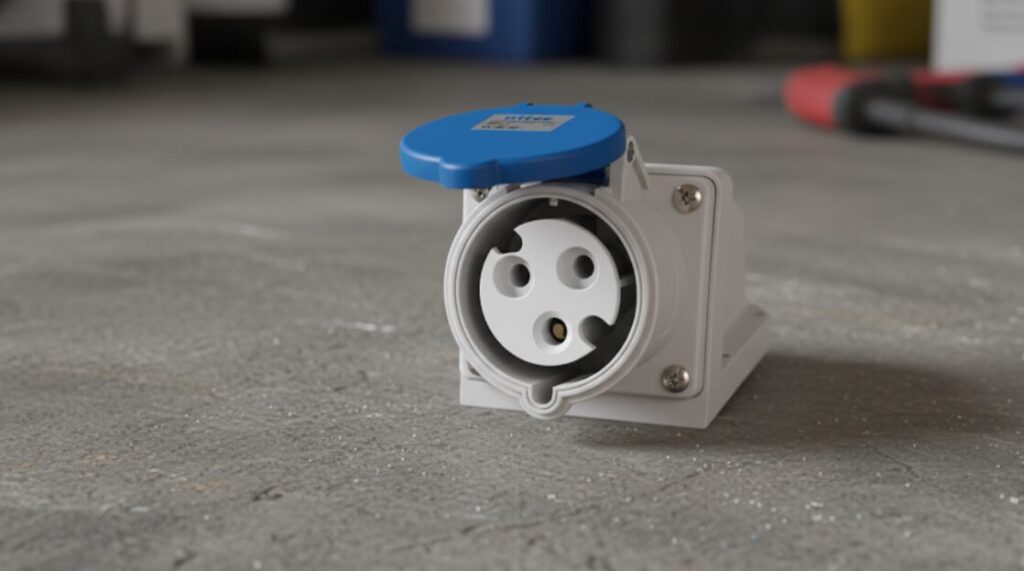
The special feature of the industrial environment is that it requires extremely high current, and is heavy machinery at every turn. When a normal gauge socket is pushed to its limit, or when the circuit is overloaded, the internal components are always in a state of thermal stress.
In this context, sparks are often the final warning. It means that the socket’s internal structure is no longer safe to carry the load. If you see scorch marks or “ablation pits” (tiny melting pits in the metal on the panels, it means the integrity of the connection has completely collapsed.
Why Is Industrial-Grade Hardware Critical To Field Safety?
Facing a sparking outlet is definitely not a problem that can be solved “by cleaning the contacts”. Once the socket has experienced severe arcing or charring, the tempering characteristics (hardness) of the metal have changed and the insulation properties have been greatly reduced.
To save expensive equipment and prevent fires, it is necessary to replace it with high-standard industrial-grade components. These components are designed to cope with harsh environments:
Maintaining tension: With a higher quality alloy, it can maintain its shape even after thousands of plug and unplug cycles.
Anti-oxidation: The contacts are specially treated to prevent contact resistance in harsh environments.
Carrying high current: With a stronger shell and highly conductive path, it eliminates overheating that causes arc pulling at the source.
Never Ignore Warning Signs
Sparking from an outlet is more than just a minor annoyance; it’s a diagnostic report from the electrical system. While tiny blue sparks are part of normal operation, any signs of heat, noise, or discoloration are urging you to take action.
Protecting commercial spaces and high-value machines starts with choosing the right hardware. When the socket is already loaded, simply replacing it with an industrial-grade component is the only way to ensure long-term reliability and prevent fire.
Author: Robert Chen
“Hi, I’m a senior industrial electrical consultant with over 11 years of field experience, I’ve seen firsthand how a misinterpreted spark can lead to catastrophic equipment failure. My career has been dedicated to overseeing electrical safety in high-demand commercial spaces and training the next generation of facility managers. I specialize in diagnosing hardware fatigue and advocating for industrial-grade solutions to ensure that every ‘click’ of a plug remains safe. “